

A plantar plate tear is a specific injury within the broader plantar plate injury category, where the soft-tissue ligament under a toe joint partially or fully gives way. Tears are graded clinically, recover at different speeds depending on grade and load management, and only rarely require surgical repair. This article covers the grading system, realistic recovery timelines, and the decision points that determine the path forward.
How Plantar Plate Tears Are Graded
Plantar plate tears are usually described on a four-grade clinical system, with grade 0 reserved for inflammation without structural compromise. The grading captures how much of the ligament has actually given way, which in turn shapes the recovery plan and the threshold for surgical referral.
- Grade 1: partial tear of the distal insertion. A small, contained tear, usually at the distal attachment under the toe. The joint is still stable on clinical testing. Patients often describe a vague ache under the ball of the foot, worsened by walking on hard surfaces or by push-off in sport.
- Grade 2: partial tear extending more proximally. The tear has progressed further along the ligament. There may be early laxity on clinical testing of the toe joint, and the patient may notice the toe starting to drift slightly upward or sideways.
- Grade 3: complete tear of the distal attachment. The toe joint is now clearly unstable. The classic “floating toe” or “V sign” can begin to appear, where the affected toe lifts off the ground or deviates away from its neighbour at rest.
- Grade 4: complete tear with extensive collateral damage. The plantar plate is fully torn and there is associated damage to the collateral ligaments. The toe sits markedly out of alignment, and conservative care alone is often insufficient to restore reasonable function.
The grading is made on clinical examination, with diagnostic imaging used to confirm the extent of the tear where the clinical picture is unclear.
Recovery Timeline by Grade
Recovery timelines are not fixed. They depend on the grade, the patient’s load, how disciplined the offloading is, and whether contributing factors like footwear and forefoot biomechanics are addressed. The ranges below are realistic clinical expectations, not promises.
- Grade 1 tears usually settle over a six to twelve week window with structured offloading, footwear adjustment, and a graded return to activity. Most patients return to normal walking comfortably within this window, with a slower return to running or jumping sport.
- Grade 2 tears take longer, typically three to six months for the symptom picture to settle and for confident return to load. A taping or strapping protocol is often part of the early weeks to support the joint while the tissue calms.
- Grade 3 tears may take six months or longer to reach a steady plateau with conservative care alone. The toe alignment often does not fully correct, even when the pain settles. This is where surgical repair starts to enter the conversation.
- Grade 4 tears rarely respond well to conservative care alone in the long run, although a conservative trial may still be reasonable for patients who are not surgical candidates.
These timelines assume the offloading is taken seriously. A patient who continues to run on a grade 2 tear will not follow a grade 2 timeline.
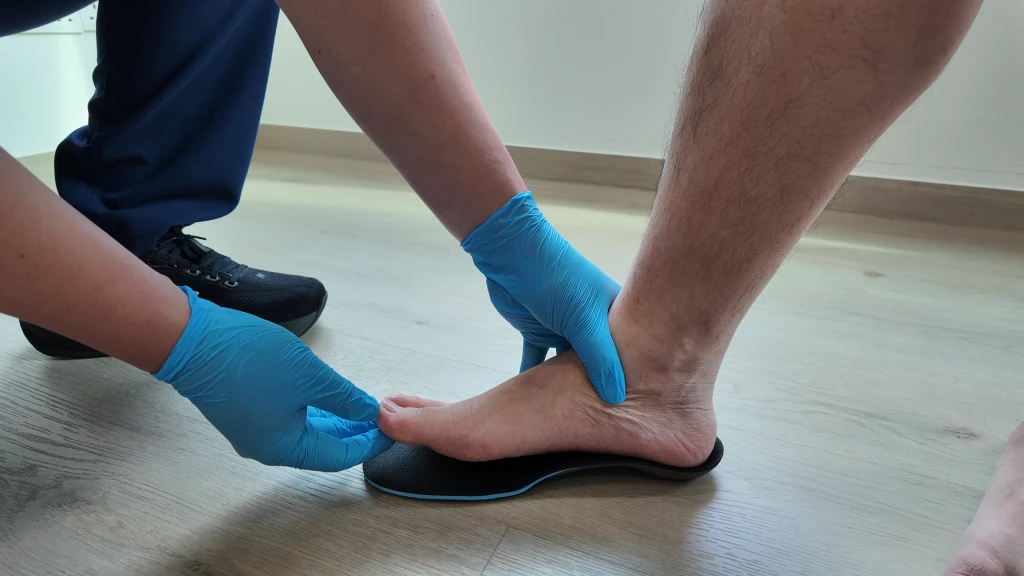
The Role of Offloading and Custom Orthoses
The single most useful intervention in plantar plate tear recovery, across all grades, is offloading the symptomatic metatarsophalangeal joint while the tissue settles. The goal is to take pressure off the joint at push-off, where the plantar plate is loaded most heavily.
Customised foot orthoses play a central role. A device built for plantar plate offloading typically includes a metatarsal dome positioned proximal to the affected joint, redistribution padding to lift load off the symptomatic ray, and where indicated a forefoot rocker through the shoe to reduce dorsiflexion demand at the joint during push-off.
Footwear matters as much as the orthotic. Shoes with a stiffer forefoot and a rocker profile reduce the load through the plantar plate at toe-off. Soft, flexible shoes do the opposite.
Taping the affected toe in slight plantarflexion is a useful adjunct in the early weeks, particularly for grade 1 and 2 tears, to keep the joint in a position that protects the healing ligament.
Where pain is slow to settle despite good offloading, adjunctive options such as shockwave therapy can be considered to stimulate the healing response in the surrounding tissues. This is more often a consideration in tears that overlap with broader metatarsalgia presentations across the ball of the foot.
When Surgical Repair Is Considered
Surgical repair is the exception, not the rule, in plantar plate tear management. It is considered when:
- A grade 3 or grade 4 tear has produced clear joint instability and progressive toe deviation that affects function or shoe fit.
- A patient has trialled structured conservative care for at least three to six months without acceptable symptom control.
- The toe deformity is progressing despite offloading, with the affected toe drifting further out of alignment.
- A grade 2 tear in a higher-demand patient is not responding adequately and is limiting essential activity.
The decision is shared. A patient who is broadly comfortable in modified footwear, even with a visibly drifted toe, may reasonably choose to live with the tear. A patient whose work or sport depends on a stable forefoot may make a different call. Neither answer is automatic.
What Surgical Repair Involves and the Trade-Offs
Plantar plate repair is performed by an orthopaedic foot and ankle surgeon, not by the podiatrist. The role of the podiatrist is to identify the tear, exhaust the conservative options where appropriate, and refer onward when the threshold is met.
The repair itself typically involves reattaching the torn plantar plate to its distal insertion through a dorsal approach, often combined with a shortening osteotomy of the metatarsal to reduce tension on the repaired ligament. In some cases an additional procedure is added to address an associated hammertoe deformity.
The trade-offs to weigh:
- Post-operative recovery involves a period of strict offloading, usually in a post-operative shoe or boot, followed by a graded return to load.
- Joint stiffness in the affected toe after repair is common and may persist.
- Some residual mal-alignment can remain even after a technically successful repair.
- The conservative pathway, while slower, avoids these surgical trade-offs entirely when it succeeds.
For most patients, the conservative pathway is tried first and tried properly. Surgery is reserved for the cases where it earns its place.
Closing
Plantar plate tears are graded by how much of the ligament has given way, and the grading drives the recovery plan. Most grade 1 and grade 2 tears recover well with structured offloading, custom orthoses, and footwear adjustment over a window of weeks to a few months. Grade 3 and grade 4 tears are where the threshold for surgical referral comes into view. The right path depends on the grade, the patient’s load, and how the case responds to a fair trial of conservative care.
If you suspect a plantar plate tear, a Straits Podiatry assessment can grade the injury clinically, set realistic timelines, and plan the offloading. Book an appointment at the clinic that suits you.