
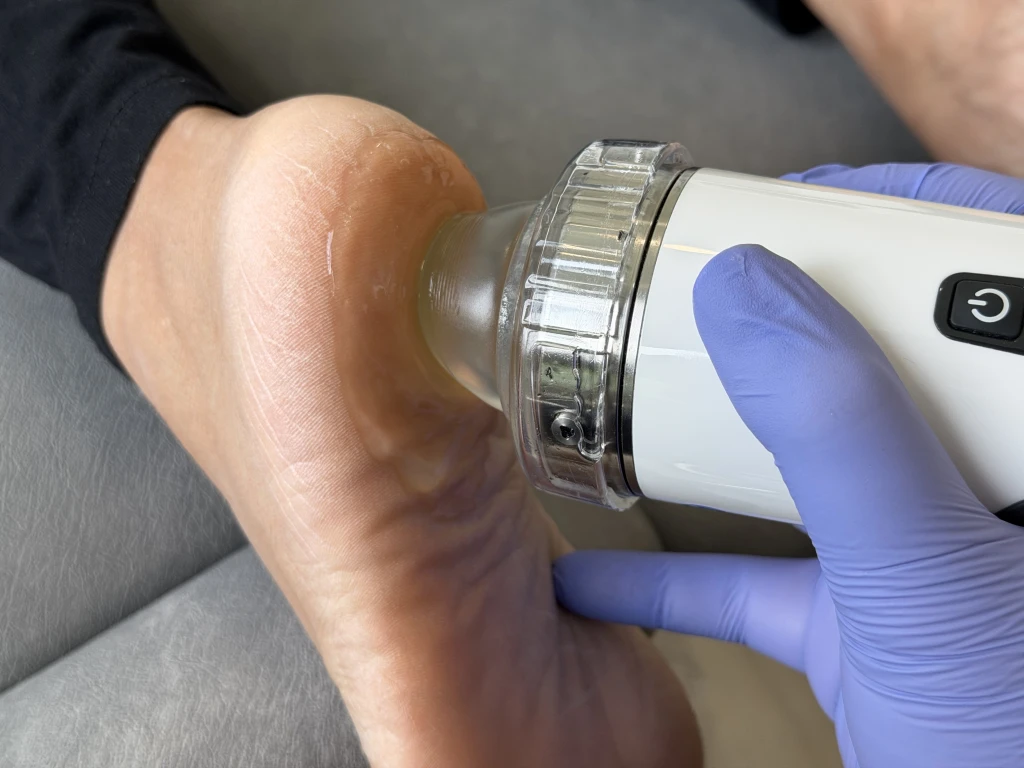
Focused shockwave therapy is one of the most evidence-supported options for plantar fasciitis that has not settled with first-line care. But it is not the right call for every case. This article walks through the clinical decision: which plantar fasciitis presentations respond best, which patients are likely to be candidates, when to delay shockwave, and the conservative steps that should usually come first.
Focused shockwave therapy is one of the most evidence-supported options for plantar fasciitis that has not settled with first-line care, with extracorporeal shockwave therapy (ESWT) the technical name for the modality used in clinic. The decision below is about when that tool earns its place in the plan.
The Conservative Steps That Come First
Most plantar fasciitis cases respond to conservative care if it is structured and consistent. Before shockwave is considered, a podiatrist will usually want to see a reasonable trial of the following:
- A loading program for the plantar fascia and calf complex, including high-load slow calf raises and intrinsic foot strengthening.
- Footwear changes appropriate to the patient’s foot type and daily load.
- Activity modification, particularly when training volume has stepped up too quickly.
- Where biomechanics are contributing, custom orthotics to redistribute load away from the medial heel.
- Stretching, taping, and short-term load reduction during flare-ups.
A six to twelve week trial of structured conservative care is the usual benchmark. Cases that have not settled after that window are the ones where shockwave starts to become a reasonable next step.
The reason this matters is straightforward. If a patient skips the loading program and goes straight to shockwave, the underlying tissue capacity issue is unaddressed. The pain may quieten, then return when load picks up again. Shockwave is most useful as a stimulus to a healing process the rest of the rehab is already supporting.
Presentations That Respond Best to Shockwave
Some plantar fasciitis presentations are more amenable to shockwave than others. The clearest candidates are:
- Chronic, recalcitrant cases, typically pain that has been present for more than three to six months and has not settled with structured conservative care.
- Imaging-confirmed degenerative change in the plantar fascia, particularly fascial thickening at the insertion.
- Localised insertional pain at the medial calcaneal tubercle, where the shockwave can be focused precisely on the symptomatic tissue.
- Cases with a stable, identifiable trigger point on clinical examination, so the treatment can be reliably targeted from session to session.
These presentations share a common feature: the tissue has shifted from acute inflammation to a degenerative state, and benefits from a stimulus that drives a fresh healing response rather than simple symptom suppression.

Presentations Where Shockwave Is Probably Not the Answer
There are presentations where shockwave is unlikely to be the right tool, or at least not yet:
- Recent-onset plantar fasciitis within the first six to twelve weeks. Most of these cases will settle with structured conservative care, and there is little reason to add an in-clinic intervention.
- Pain that is clearly not coming from the plantar fascia. Tarsal tunnel irritation, calcaneal stress reaction, fat pad atrophy, and S1 referred pain can all mimic plantar fasciitis. Shockwave to the plantar fascia will not help any of these.
- Generalised plantar pain without a focal trigger point. If the symptomatic tissue cannot be pinpointed, the therapy cannot be targeted accurately.
- Pain pattern that does not fit a classic plantar fascia presentation, for example pain that is worse at rest than on first-step loading, or that is associated with night pain or systemic features.
When the pattern does not fit, the better next step is usually further assessment and imaging, not more intervention.
Patient Factors That Affect Candidacy
Beyond the clinical presentation, patient factors also shape the decision:
- Pregnancy is a contraindication for shockwave to the lower limb. Treatment is deferred.
- Active local infection or open skin lesions at the planned treatment site need to settle first.
- Coagulation issues or blood-thinning medication require a careful conversation. Shockwave is not absolutely contraindicated in all of these cases, but the risk-benefit shifts and the treatment parameters may need to be adjusted.
- Realistic expectations about the timeline. Shockwave is not an instant fix. A typical course runs over several weekly sessions, and clinical improvement often continues for weeks after the last session as the healing response plays out.
A candid conversation about these factors usually happens at the assessment, not at the first treatment session.
What the Decision Process Looks Like in Clinic
In a Straits Podiatry consult for suspected plantar fasciitis, the decision sequence is roughly:
- Confirm the diagnosis with a clinical examination, looking at first-step pain, windlass mechanics, palpation of the medial calcaneal tubercle, and a screen for differential causes.
- Review the conservative care that has already been tried, honestly. A loading program that was tried for two weeks and abandoned is not a failed trial.
- Decide whether shockwave is the right addition now, or whether the patient is better served by a more structured loading program, an orthotic intervention, or further imaging.
- If shockwave is appropriate, plan a course over several weekly sessions, with the loading program continuing in parallel.
- Reassess at the midpoint and adjust the parameters or the rehab in response to the early signal.
The patient leaves with a plan they understand, including what to expect, what to keep doing, and what would change the plan.
Closing
Shockwave is a useful tool for plantar fasciitis that has not settled with first-line care, but it is not the first answer for every heel pain presentation. The decision turns on the chronicity of the case, the clinical pattern, the imaging picture where relevant, and the patient’s broader context. When those factors line up, shockwave is one of the better-supported options available. When they do not, the answer is usually a tighter version of the conservative plan, not a faster jump to the in-clinic intervention.
If you have been carrying heel pain for more than a few months and are weighing up whether shockwave is the right next step, book a consultation and we can map the decision in person. If you want to compare options before committing, shockwave versus cortisone injection walks through the trade-offs, and the plantar fasciitis recovery timeline sets expectations for how long the conservative pathway takes.