
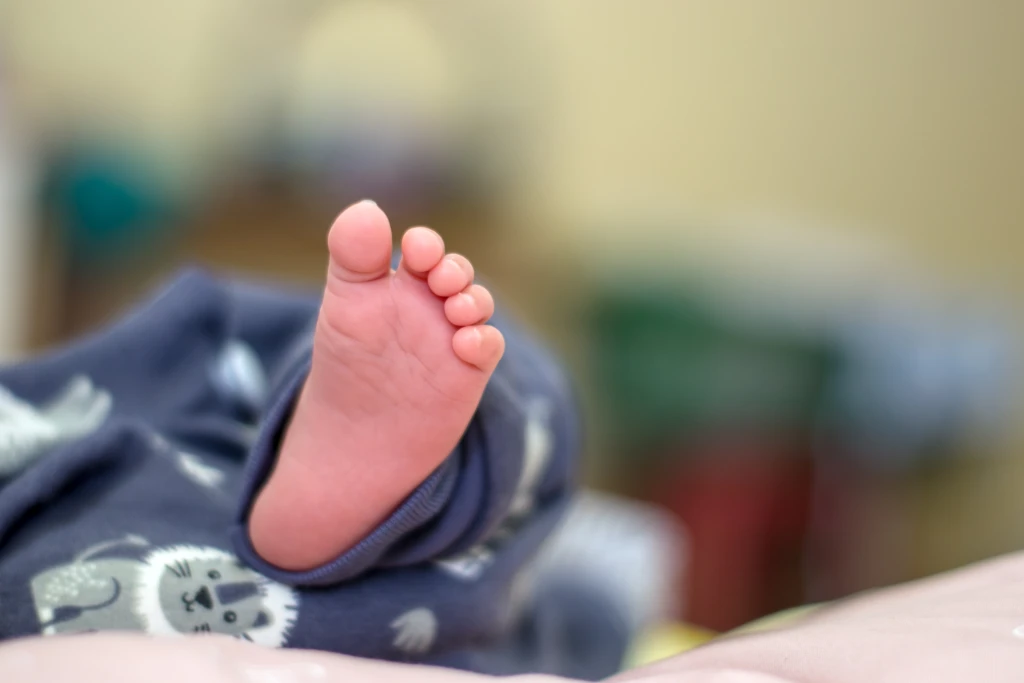
Many parents notice it during a nappy change or the first pair of soft shoes. The baby's foot looks a little curved. The inner border seems to bend inward. A late-night search throws up frightening-sounding terms: metatarsus adductus, clubfoot, in-toeing, skewfoot.
This guide walks through the four findings parents most often confuse, what each looks like, and when an assessment is worth booking.
What You're Looking At: The Four Baby-Foot Findings Parents Often Confuse
When a baby's foot looks "off", it almost always falls into one of four categories. They can look similar at first glance but sit on different parts of the worry scale.
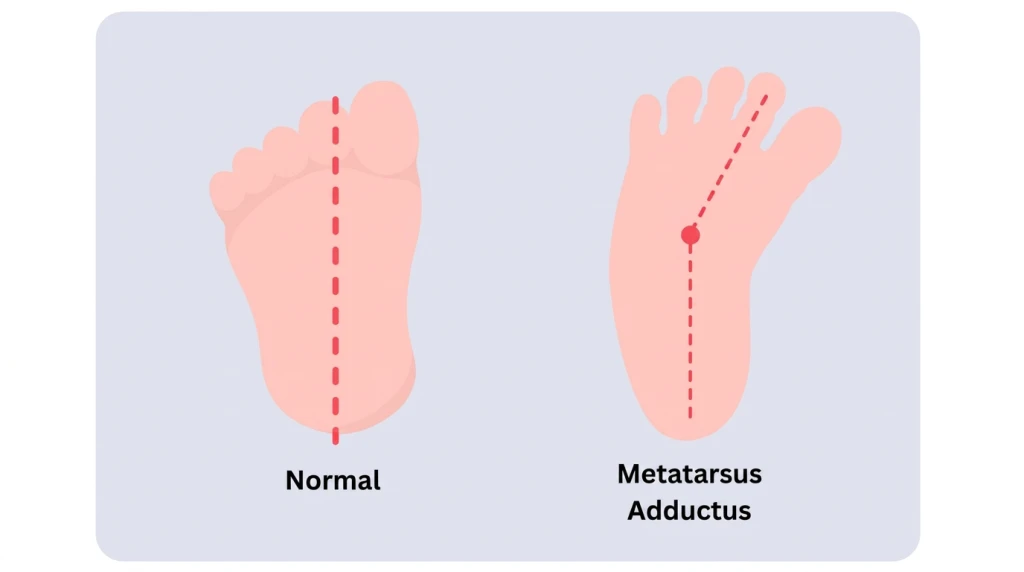
- Metatarsus adductus. Forefoot curves inward, heel straight, sole looks like a soft "C". Most common of the four. Usually flexible and most cases settle in the first one to two years.
- Clubfoot (talipes equinovarus). The whole foot turns inward and downward. The heel is involved, not just the forefoot, and the foot is stiff in every direction. Needs early specialist treatment, usually picked up at birth or on the antenatal scan.
- In-toeing. The foot itself may be straight, but the child walks with toes pointed inward. The cause sits higher up, at the hip or shin. Often only noticed once the child starts walking.
- Skewfoot and hallux varus. Rarer. Skewfoot looks like metatarsus adductus but the heel is tilted outward too. Hallux varus is when only the big toe drifts inward.
A quick check at home: turn the sole up and look at it from below. Forefoot curve with a straight heel points to metatarsus adductus. Whole foot turning in and down points to clubfoot. A straight foot that only in-turns during walking points to in-toeing.
Metatarsus Adductus: The Most Common, Usually Flexible, Usually Self-Corrects
Metatarsus adductus is the one most parents end up Googling, and the one that usually does well on its own.
How it looks. The front half of the foot curves toward the midline. The inner border of the sole has a soft "C" shape and the heel sits in a normal position. Some babies have a small crease along the inner border. Shoes wrinkle on the inside.
What causes it. Most evidence points to the baby's position in the womb. Tight space in late pregnancy holds the forefoot inward long enough for the curve to persist after birth. More common in firstborns, breech babies, twins, and babies whose mothers had low amniotic fluid.
What to expect. Most cases are flexible, meaning the forefoot can be guided gently back to straight with light pressure. Flexible cases usually correct on their own in the first one to two years. A smaller group of feet are rigid and benefit from earlier treatment: passive stretching taught by a podiatrist, sometimes reverse-last shoes, occasionally serial casting in the first year.
The assessment is mostly to tell flexible from rigid, and earlier is better if treatment is needed.
Clubfoot: The One That Needs Urgent Treatment, and Looks Different
Clubfoot is the finding parents are most afraid of, and the most distinct once you know what to look for.
How it looks. The whole foot, not just the forefoot, turns inward. The heel is pulled up and inward and the foot points downward, as if the baby is on permanent tip-toe. Stiff in every direction. Both feet are affected in around half of cases. Family history raises the risk.
What to expect. Clubfoot is almost always picked up on the antenatal scan or by the paediatric team in the delivery suite. Treatment is led by paediatric orthopaedics, starts in the first weeks of life, and uses the Ponseti method: a series of casts, sometimes a small tendon procedure, then a foot abduction brace at night for several years.
If your baby has metatarsus adductus, you have not missed clubfoot. Metatarsus adductus is forefoot-only and flexible in most babies. Clubfoot is whole-foot, rigid, and usually flagged before you leave the hospital.
Positional In-toeing: From the Hip or Shin, Not the Foot Itself
In-toeing is the one parents tend to notice later, often around first steps.
How it looks. The foot itself, on the changing mat, can be perfectly straight. The "off" appearance only shows up during walking, when the toes point inward. Tripping is common, and some toddlers sit on the floor in a "W" position.
What causes it. The rotation usually sits above the foot. The two common drivers are internal tibial torsion (an inward twist of the shin bone, usually unwinds on its own as the child grows) and femoral anteversion (an inward rotation of the thigh bone, often visible around ages 3 to 5 and slowly improves into late childhood). Metatarsus adductus itself can also drive the in-toed gait, which is why an in-toeing assessment checks hip, shin, and foot together.
What to expect. Most positional in-toeing improves with growth and does not need active treatment. Reasons to seek an assessment: it is only on one side, it is getting worse, the child trips often or struggles to keep up with peers, or there is pain.
Skewfoot and Hallux Varus: Rarer, but Worth Knowing
Less common, but parents sometimes land on them while searching.
Skewfoot looks like metatarsus adductus at first. The difference is the heel: it tilts outward rather than sitting straight, giving the foot an "S" shape rather than a clean "C". Usually more rigid and presents later. Needs in-person assessment because the treatment differs.
Hallux varus is when only the big toe drifts away from the second toe. The rest of the foot looks fine. Often mild and flexible in babies. Worth a check if it is rigid, getting worse, or causing footwear problems.
If the picture does not match metatarsus adductus (whole foot involved, heel turned outward, only the big toe affected, getting worse), an assessment is worth booking.
When to See a Paediatric Podiatrist, and What the Appointment Looks Like
Most curved baby feet do not need urgent action. An assessment is worth booking when:
- The foot is stiff and does not straighten with gentle guidance.
- The whole foot, including the heel, turns inward and points down.
- Only one foot is affected and looks very different from the other.
- The curve is getting more pronounced over the months.
- Your child trips often once walking, or struggles to keep up with peers.
- There is a family history of clubfoot, metatarsus adductus, or hip dysplasia.
- You are unsure and would prefer a clear answer before the next milestone.
What the appointment looks like. A paediatric podiatry assessment is unhurried and built around the child. The podiatrist takes a short pregnancy and birth history, asks about milestones, and observes the baby on the mat. Hands-on examination tests flexibility (Bleck's test for metatarsus adductus), checks heel and hindfoot position, and screens hip and shin rotation when in-toeing is in the picture. Imaging is rarely needed at the first visit.
You leave with one of three answers. The foot sits within the normal range, and the plan is monitoring. The foot is flexible, and a parent-delivered stretching routine with a short follow-up is worthwhile. Or the foot is rigid (or the picture is more complex), and earlier active treatment is recommended.
At Straits Podiatry, our podiatrists see paediatric foot and gait cases across all three clinics in Buona Vista, Orchard, and Paya Lebar, and paediatric assessment is part of what each clinic offers. Book an appointment at the clinic most convenient for your family.
A curved baby foot is one of the more anxiety-inducing things a new parent notices. Most of the time it turns out to be the most reassuring finding on the list.