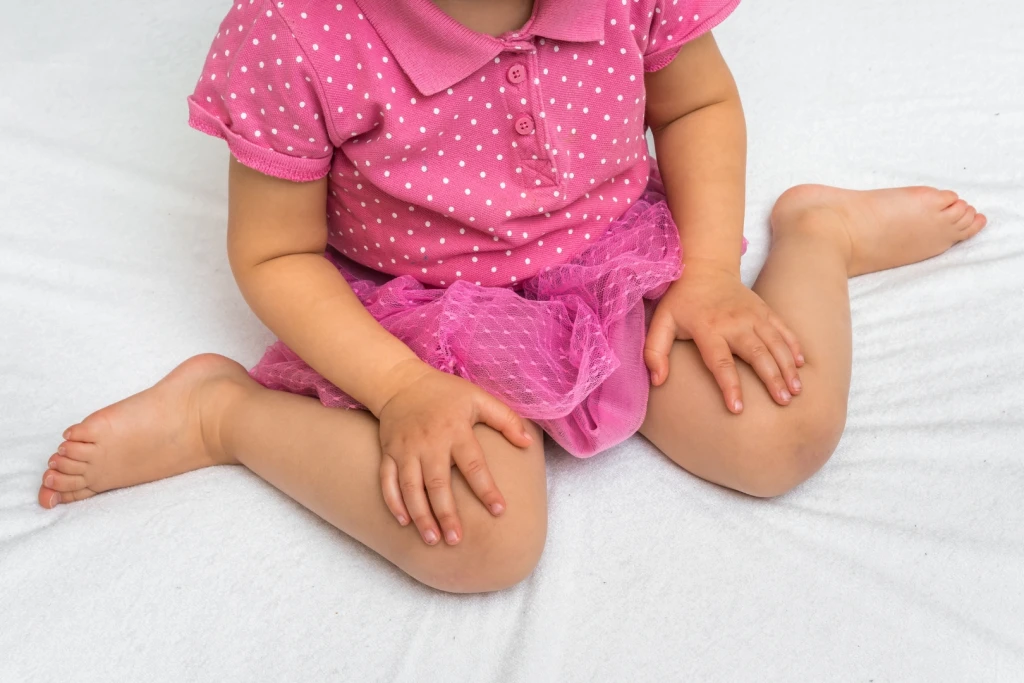
You glance across the living room, and there it is again: your child sitting on the floor with both legs splayed out to the sides in a neat letter W. Bottom flat on the ground, knees bent forward, a tower of blocks going up between the hands. You have read somewhere that this W-sitting is not ideal, so you say what you always say, “Legs in front, please.” They shuffle round for about ten seconds, then slide straight back into the W the moment the tower needs another block.
If that scene is familiar, your instinct to steer them out of it is a sound one. W-sitting is one of the most common things parents ask me about, and my honest view, which is the view we take at the clinic, is that it is a habit worth gently limiting rather than ignoring. It is not that a single sit does any harm. It is that the position feeds a pattern I would rather not see reinforced. Let me walk you through the questions parents ask me, roughly in the order they come up, and explain where I land and why.
Why does my child sit like this?
A child sits in a W because it works for them. Splaying the legs out to the sides gives a wide, stable base, a bit like widening the legs of a tripod. That stability means the child does not have to work as hard through the trunk and core to stay upright, which frees both hands for building, drawing, and pushing toy cars around.
There is usually an anatomical reason it feels so natural, too. In many young children the top of the thigh bone is turned slightly inward where it meets the hip, something you may see described as femoral anteversion. That inward set lets the hips turn in far more easily than they turn out, and the W is simply the shape the legs fall into when a child with inward-set hips sits straight down between them. The same inward rotation is why a lot of these children also walk with their toes pointing inward, the pattern I cover on our page about in-toe walking. So W-sitting and in-toeing often travel together, because they share the same root in how the hips are built and how they rotate.
Is W-sitting bad for the hips and legs?
Here is where I differ a little from the “it is completely harmless, leave it alone” line you will find on some sites. My concern is not that an occasional W deforms a growing skeleton. It is that W-sitting parks the hips in that inward-rotated position for long stretches, every day, and a habit repeated that often tends to reinforce the very pattern we would rather see settle.
In a young child, the inward set of the hip, the femoral anteversion that sits behind in-toeing, is meant to unwind gradually with growth, so the toes point more forward as the years go on. My clinical view is that a child who spends hours in a W, day after day, is holding the hips in that inward position and giving the natural unwinding less room to happen. That is why, at the clinic, we recommend limiting W-sitting rather than dismissing it as nothing, particularly in a child who already in-toes or drops into a W by default. To be fair about it, this is clinical reasoning and judgement, not a claim that one sitting position guarantees a lasting problem. But when the downside of encouraging a different way to sit is essentially zero, I would rather we nudge in the better direction.
How do I get my child to stop, without the constant nagging?
Standing over a three year old correcting their legs every few minutes tends to backfire. It turns floor play into a battle and teaches the child nothing useful. What works better is to make the other positions the easy, obvious choice, so the W stops being the default.
A few things that help. Offer criss-cross sitting (legs folded in front, sometimes called ring or tailor sitting) and side sitting, where both legs fold to one side and then swap, so they learn both sides. Pop them on a low stool or a small chair at a child-sized table for puzzles and colouring, which takes floor-sitting out of the equation entirely. Set up play that pulls them off their bottom altogether, like kneeling at the sofa to push cars along the cushion, climbing, or reaching up for things, because active play builds the trunk strength that makes upright sitting feel less like hard work. When you do redirect, keep it light. A cheerful “criss-cross, applesauce” as you hand over the next block lands far better than a scolding. The aim is steady redirection, not policing every second.
When should I get it checked by a podiatrist?
Gentle redirection at home is enough for many children. There are a few signals, though, that tell me it is worth having a podiatrist actually look, and they are less about the W itself and more about what travels with it.
Book a look if your child in-toes noticeably when they walk and run, if the W is the only way they can sit and they genuinely cannot hold a criss-cross or a side sit, or if you are seeing frequent tripping and falling that is not settling as they get older. It is worth checking if your child seems floppy or low in muscle tone, tires quickly, leans on furniture a lot, or was late to reach milestones like walking, running, or climbing stairs. The same goes if you notice their feet rolling flat when they stand, which I talk through on our page about flat feet in children, or if one leg looks or moves differently from the other. Any pain is always worth a visit. None of these means something is wrong on its own, but together they are the picture that tells me the sitting posture is worth understanding properly.
So what should you actually do about it?
The practical answer has two halves. First, approach W-sitting as a habit worth limiting: keep offering and rewarding other ways to sit, so the hips are not parked inward for hours every day. Second, watch the company it keeps. Where the W travels with in-toeing, tripping, low muscle tone, or delayed milestones, that is when a proper look earns its place.
A paediatric podiatry assessment is built around watching, not lecturing. We watch how your child sits, stands, walks, and runs, we check how far the hips rotate in and out, we look at muscle tone and joint flexibility, and we place it all against where they should be for their age. Gait analysis helps us see the walking pattern properly rather than guessing from a single glance. From there, management is usually the calm kind: reassurance and simple home strategies for many children, including steering them out of the W, a targeted strengthening programme through our physiotherapist for those who need to build trunk and hip control, and custom orthotics only in the smaller number of cases where the feet themselves need support. Every one of our podiatrists sees children, so you are not tied to one clinic or one person.
If your child’s W-sitting comes with any of the signals above, or you would simply feel steadier having someone look, you can book an appointment with any of our podiatrists in Singapore at any of our three clinics.