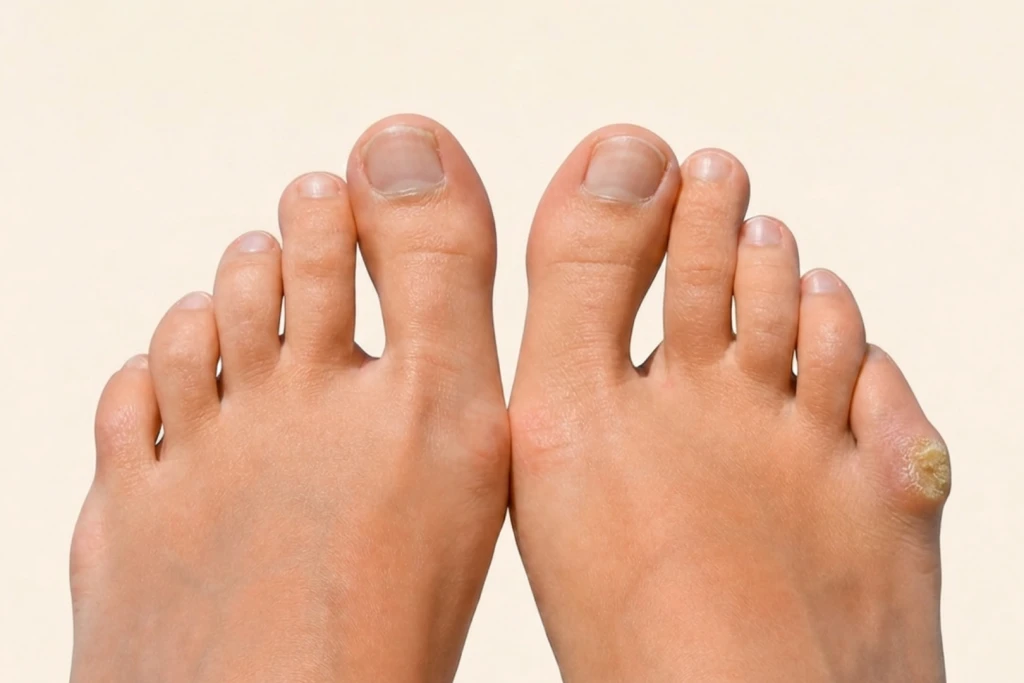
Most people know what a bunion is, but far fewer know the same thing can happen at the other end of the foot, where a bony bump pushes out on the little-toe side and the little toe drifts in toward its neighbour. It looks like a bunion gone to the wrong side of the foot, and that is exactly what it is. The patients who come in about it have usually spotted the shoe rubbing there, the skin going red or hard over the spot, and the bump slowly becoming more obvious. That it sits on the outer edge rather than the inner one is the part that throws people.
What they are describing is a bunionette, sometimes called a tailor’s bunion. It is the little-toe-side cousin of the more familiar bump at the big toe. The day-to-day nuisance, the rubbing inside a narrow shoe, is almost identical. What my patients really want to know is what it actually is, and whether it is going to keep getting worse. So when a foot like that turns up, here are the questions I tend to work through with them, roughly in the order they come up.
First, what exactly is this bump?
A bunionette is a bony prominence at the head of the fifth metatarsal (the long bone that sits behind your little toe). When that bone angles outward, away from the rest of the foot, its head starts to stick out at the side. At the same time the little toe itself often leans inward toward the fourth toe. The result is a bump on the outer border of the forefoot. The skin over it takes the brunt of the pressure.
The big-toe bunion does the mirror image of this. There, the first metatarsal drifts outward and the big toe leans toward the second toe. The bump ends up on the inner side of the foot. So both follow the same logic: a long bone splaying away from the midline while the toe leans toward it. The bunionette is simply the version that shows up on the little-toe side. That is why people are surprised to be told it belongs to the same family.
The old name “tailor’s bunion” is a leftover from another era. Tailors sat cross-legged for long hours, resting the outer edge of the foot against the floor. The pressure got the blame for the bump. We understand it differently now, but the name stuck.
Why did it form on my little toe?
The honest answer is that it is usually a combination of how your foot is built and what you ask it to do. The structure tends to come first.
Some people inherit a fifth metatarsal that sits at a wider angle. Others inherit a head that is naturally more prominent, or a slightly bowed shape to the bone. If the bone is positioned to splay outward, the bump has a head start before footwear ever enters the picture. That is why a bunionette can run in families. It is also why you can have one on a foot that has never been forced into a tight shoe.
Foot type plays a part too. Feet that flatten and splay under load place more pressure along the outer forefoot with every step. Over years, that repeated load can coax the fifth metatarsal further out of line. The bump rarely appears overnight. It is the slow product of structure and load working together.
So is footwear to blame, or not?
Footwear does not usually create a bunionette out of nothing, but it does two things that matter. It can speed up the drift. And it is almost always the reason the bump becomes painful in the first place.
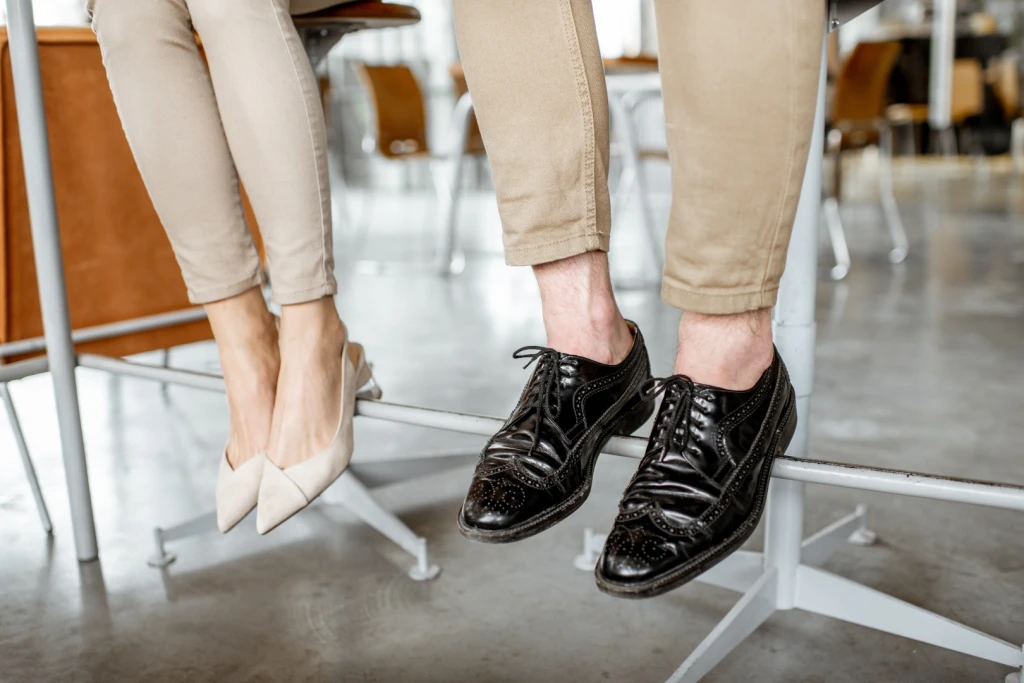
A shoe that narrows sharply at the front squeezes the forefoot from both sides. The little toe gets pushed inward, the bony prominence gets pressed against the side of the shoe, and the skin over it is caught in between. In Singapore I see this in two groups especially. The first is anyone in narrow dress shoes or pointed heels for long office days. The toe box tapers, and there is nowhere for the forefoot to spread. The second is people who only get relief in the evening, when they finally swap into sandals.
The heat and humidity add their own twist. Feet swell more in the warm and they perspire. A shoe that felt fine in the morning can feel a size too tight by mid-afternoon. That extra swelling presses the bunionette harder against the shoe wall. Over time hard skin builds, sometimes with a corn right over the bump where the friction is worst. None of this changes the underlying bone. But it explains why a bump that sat quietly for years suddenly starts to complain.
Is the pain the bone, or the skin over it?
This is worth separating out, because it changes what we focus on. The bony prominence is the structural part, and it does not shrink on its own. But most of the discomfort people actually feel comes from the surface. The skin reddens, thickens, and forms a corn or callus. Occasionally an inflamed sac of fluid (a bursa) builds up over the bump in response to repeated friction.
That distinction is useful, because the surface problems are very manageable even though the bone is fixed. A great deal of the relief my patients get comes from taking the pressure off the skin and giving the forefoot more room. It rarely comes from doing anything to the bone at all.
What helps, and when is surgery considered?
Most bunionettes are managed without surgery, and the goal is straightforward: reduce the pressure on the bump, calm the irritated skin, and slow any further drift where possible. None of this reverses the bone. But it can make a painful bunionette comfortable again and keep it that way.
The starting point is almost always footwear. A wider, deeper toe box gives the forefoot room to sit without the little toe being crushed inward. Soft, flexible uppers stop the shoe wall pressing on the prominence. For office wear in Singapore that often means choosing the roundest, widest dress shoe you can get away with, and switching out of narrow shoes the moment the day allows.
Around that, a few things help. Padding or a small gel sleeve over the bump cushions it against the shoe. A toe spacer can ease the inward lean of the little toe and relieve the rubbing between the fourth and fifth toes. Where hard skin or a corn has built up over the prominence, having that professionally reduced removes a surprising amount of the day-to-day soreness. Doing it carefully matters far more than people assume.
What about the pressure coming from underneath?
The part that is easy to overlook is the load coming up from underneath. If your foot is flattening or splaying in a way that keeps driving pressure into the outer forefoot, addressing that takes some of the ongoing strain off the fifth metatarsal. This is where an assessment of how you actually walk earns its place. It is also where custom foot orthotics can redistribute pressure away from the outer border of the foot rather than only easing the bump where it sits.
Surgery exists for the minority of bunionettes that stay painful despite all of this. But it sits at the far end of the pathway, not the start of it.
Okay, what would you do if you were me?
If the bump is purely cosmetic and never bothers you, it does not necessarily need anything done. But it can start to interfere: persistent rubbing and redness, a corn that keeps coming back over the bump, pain that limits which shoes you can wear, or a little toe drifting further over time. That is the moment I would have it looked at rather than keep working around it. If the skin ever breaks down over the prominence, that is worth attention sooner rather than later, particularly for anyone with diabetes or reduced sensation in the feet.
A proper assessment looks at the whole picture, not just the bump. It reads how the fifth metatarsal is positioned, how the forefoot loads when you walk, and what the skin over the prominence is doing. From there the plan might include professional reduction of any corn or callus over the bump, padding or toe-spacing advice, and footwear guidance suited to a Singapore working day. Where the underlying load is the driver, custom orthotics come in to redistribute the pressure. The honest goal is a comfortable, quiet bump that stops dictating your shoes, not a brand-new bone.
If a bony bump on the outside of your little toe has started dictating which shoes you can wear, you do not have to keep living around it. Book a consultation with any of our podiatrists in Singapore at Straits Podiatry, at any of our three locations, for an assessment and a plan to manage it.