Corn plasters are one of the most misused products I see in clinic, and the name is a big part of the problem. People assume that something called a corn plaster must be the answer for a corn. It usually is not. Most weeks I see feet that are more painful, more damaged, or outright infected because of one, and a worrying share of them belong to children whose parents were only trying to help. The confusion runs deep enough that I regularly find myself advising GP colleagues on it too, so that salicylic acid and corn plasters are not handed out before anyone has worked out what the lesion actually is. There is so little clear information out there that I want to set the record straight.
Here is the part that catches everyone out. A corn plaster is the wrong tool for a corn, and the acid it contains is actually better suited to a mild wart. Once you understand why, the rest of it makes sense.
Do corn plasters work for corns?
No, and it is worth understanding why not. The medicated part of a corn plaster is salicylic acid, and all it does is burn off a layer of hard skin. That thins the build-up for a short while, but a corn is not really a skin problem, it is a pressure problem. A corn forms because one small area of skin is taking too much pressure or friction, usually over a bony spot, and it thickens to protect itself. Burning the surface off does nothing about the pressure underneath, so the corn simply comes back.
The bigger issue is what you are left with in the meantime. You have created a raw, acid-burned patch of skin at the exact point that carries the most load every time you stand or walk. Think about that for a moment. You are chemically burning into the one spot on your foot that takes the most pressure. It does not add up, and that mismatch is how a manageable corn turns into a wound.
So what are corn plasters actually for?
Mild warts, as it turns out. A plantar wart is a viral skin infection, and here salicylic acid has a real, if modest, role. It burns off the infected surface layer, and if the process reaches and clears the root, the wart can settle. The evidence agrees. A Cochrane review of topical wart treatments found salicylic acid has a definite but modest effect on warts, although it works better on the hands than the feet and needs weeks of daily use.
The two catches are large ones. It only helps if the problem is genuinely a wart, and it only helps if it is used safely. Most of the damage I see comes from getting one or both of those wrong.
Corn or wart? Five ways to tell them apart
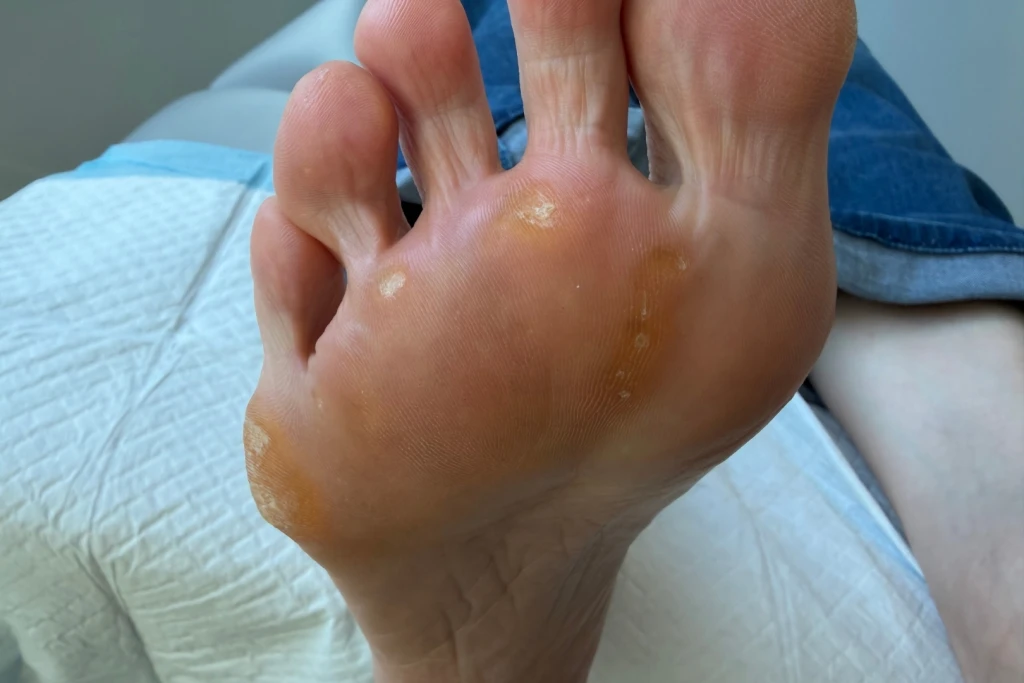
This is where it all starts, because acting on the wrong assumption is how the trouble begins. Here is how I tell them apart:
| Feature | Corn | Wart (verruca) |
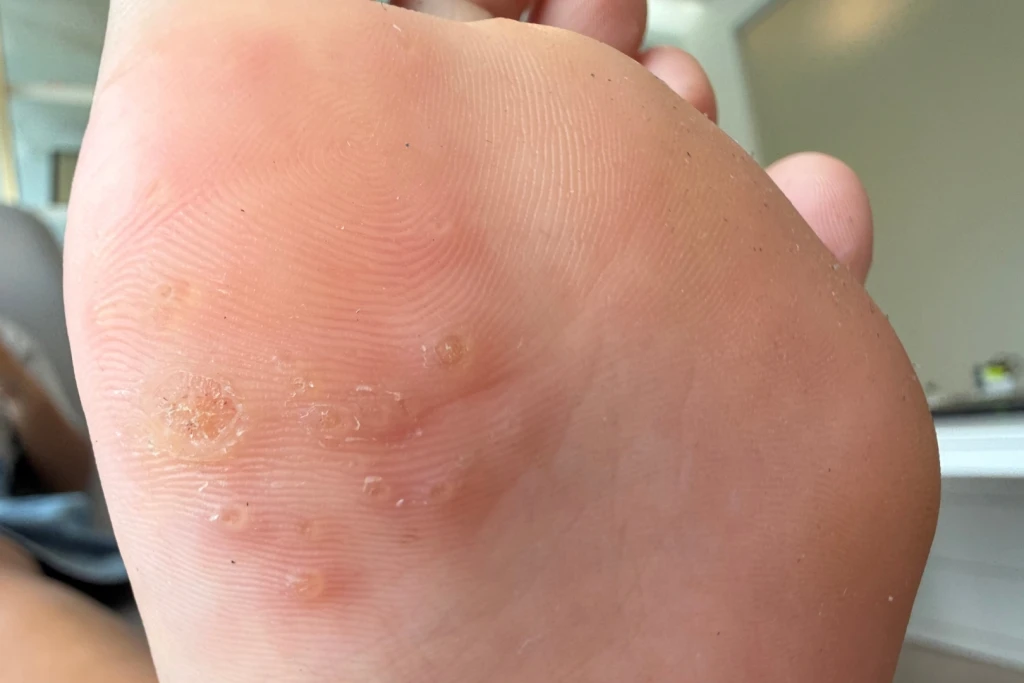
| Shape | Hard skin with a central core | A rougher, cauliflower-like surface |
| Skin lines (striations) | The skin lines run across it, uninterrupted | The skin lines stop at the edge of the lesion |
| Tiny black dots | None, though a deep corn may bleed from within, but not as scattered dots | Often present, from tiny capillaries feeding the virus |
| Where it appears | On weight-bearing spots such as the big toe, the ball of the foot, or the heel, because pressure drives it | Anywhere on the foot |
| Pain when squeezed | Hurts with direct pressure, not usually when pinched | Hurts more when pinched from the sides than when pressed straight down |
If you cannot say with confidence which one you have, that on its own is a good reason not to reach for the acid. Why start a treatment without a diagnosis? Even if it worked for a friend, can you be sure you have the same thing they did?
What I see when corn plasters go wrong
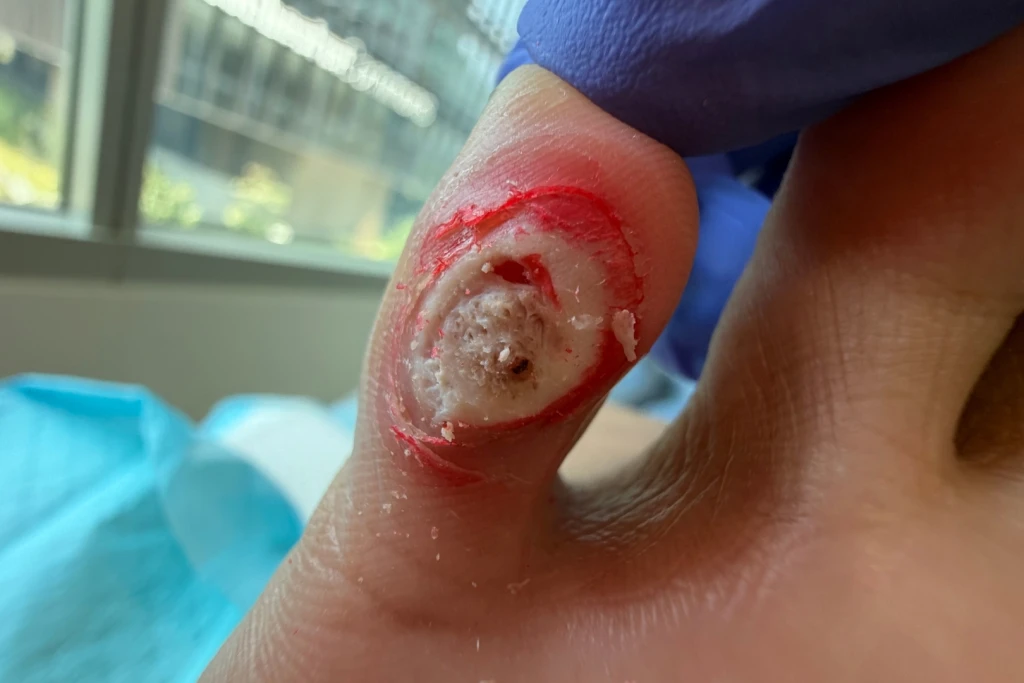
The most common look is heavy maceration, where the skin turns white and soggy with a rim of redness around the lesion, and it hurts more, not less, when pressure is applied. With continued use, and I often hear that someone has used one daily for two to three weeks, that soft skin breaks down into a hole, and you can see the raw granulation tissue, the flesh, underneath. The less fortunate ones develop a pocket of pus under that macerated skin, and the moment I debride it, the pus flows out.
The ones that worry me most are people with diabetes. They may have no sensation in the foot, so they keep self-treating with a corn plaster feeling nothing, and by the time they come in the toe is swollen and the area has turned cellulitic. What began as a corn has become an infection that puts the whole toe at risk.
Who should never use a corn plaster
The honest answer is that nobody should use one without first knowing what they are treating. Beyond that, some groups carry far too much risk to self-treat with acid at all:
- Anyone with diabetes.
- Anyone with poor circulation.
- Older adults over about 75, because reduced circulation is common and often undiagnosed.
- Anyone who is immunocompromised.
- Children under about 7, and not without professional guidance even then.
For these groups, a small acid burn can turn into a wound that is slow to heal and quick to become infected. It is not worth the gamble.
Corn plasters on children: a note for parents
I want to speak to parents directly here, because this is the group that frustrates me the most to see hurt. A parent cannot reliably diagnose what is on their child’s foot, and more often than not the culprit is a verruca rather than a corn. A child’s skin is thinner and far more sensitive to an acid product, so most of the children I see after a corn plaster end up with inflammation and pain. It is usually made worse because the acid gets applied over a wide area rather than just the spot, which burns the healthy skin around it.
Please have it looked at before treating it at home. It is not worth saving a consultation fee only to cause your child more harm, and in my experience it almost always ends up costing more to put right.
If you are going to use a plaster anyway, use it safely
If, after all that, you still want to try a plaster, and you are not in any of the higher-risk groups above, a few rules make it much safer:
- Apply the acid to the affected skin only, never the healthy skin around it.
- Protect the surrounding skin. A donut-shaped pad or a ring of tape around the lesion keeps the acid off the good skin.
- Do not use it for more than two weeks in a row.
- Stop immediately if the pain increases, or if any redness or swelling appears, and get it seen.
The safest thing you can do at home, though, is gentler than any acid. Filing the excess hard skin down with a foot file often eases the pressure and the pain, whether it is a corn or a wart, without the risk of a burn or a wound. Wearing more cushioned shoes helps take the pressure off too.
What actually solves a corn or a wart
Self-care can hold things steady, but the real fix depends on getting the diagnosis right first. In clinic, a corn can be reduced painlessly there and then by removing the hard skin and the core, and the more important part is working out what is driving the pressure so it stops coming back, whether that is footwear, a bony prominence, or how you load the foot. A wart is a different problem, and if it is already large or deep, we can look at options such as cryotherapy or wart needling where they are appropriate, to clear it safely before it spreads.
So the bottom line is this. Corn plasters are never for corns. Using one only risks more harm without solving the problem. Get yourself checked and find out what the issue actually is, so you are not treating it blindly. If you are not sure what is on your foot, book a consultation with any of our podiatrists at any of our three clinics in Singapore, and we will tell you exactly what you are dealing with.
Frequently Asked Questions About Corn Plasters
Do corn plasters work for corns?
Not really. Salicylic acid burns off a layer of hard skin, but a corn is driven by pressure and friction, so it returns once the surface grows back. Meanwhile you are left with an acid-burned patch on the spot that takes the most load, which can turn a corn into a wound. Removing the corn and addressing the pressure is what actually helps.
Can you use a corn plaster on a wart?
A mild wart is the one situation where the acid has a genuine, if modest, role, because it can burn off the infected skin. It only helps if the lesion really is a wart, if the surrounding healthy skin is protected, and if it is used safely. If you are not certain it is a wart, have it checked first.
Are corn plasters safe for children?
They are not a good idea for young children. A child’s skin is thin and sensitive to acid, the problem is often a verruca rather than a corn, and the acid is easily applied too widely and burns the healthy skin. Children under about 7 should not use one without professional guidance. Have it assessed instead.
How long can you use a corn plaster?
If you use one at all, do not use it for more than two weeks in a row, apply it only to the affected skin, protect the skin around it, and stop at once if pain, redness, or swelling appears. Anyone with diabetes, poor circulation, or a weakened immune system should not use one at all.
References:
- Topical treatments for cutaneous warts, Cochrane Database of Systematic Reviews.