
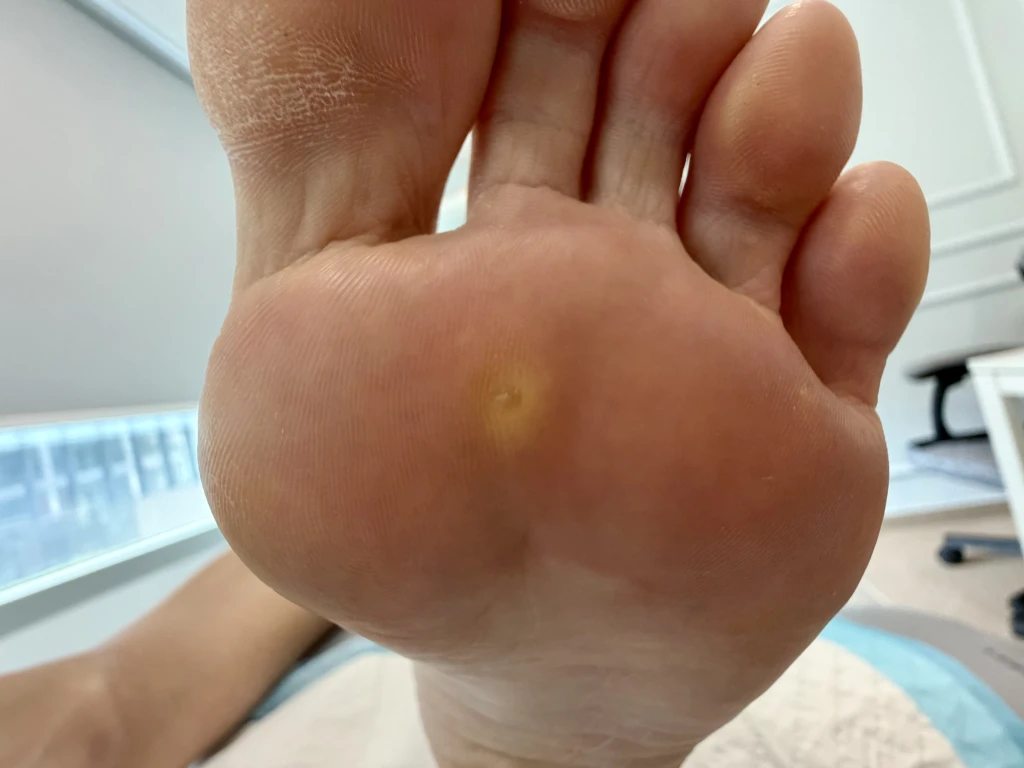
You just had your corn shaved. Walking felt easier for a few weeks. Then the same sharp pinpoint pain came back, in the same spot, and the same hard patch of skin started to rebuild. It is the most common reason patients come back to see me for foot corns, and the cause is almost always the same: the pressure that built the corn was never taken off.
The Corn Recurrence Cycle Nobody Explains
A foot corn is not really a skin problem. It is the skin's response to a mechanical problem. When one small area of your foot takes the same load every step, the skin thickens to protect the tissue underneath. The thickened skin then focuses that pressure into a denser core, which produces the pinpoint pain when you stand or push off in a shoe.
The recurrence cycle goes like this. The corn is shaved, so the painful core is gone and the area feels flat. The pressure pattern that created it is unchanged. The same shoe is still pressing on the same toe joint, or the same bony spot under the ball of the foot is still loading harder than its neighbours. Within four to eight weeks, sometimes faster in hot weather when feet swell more inside shoes, the skin rebuilds the same protective layer.
Removal addresses the symptom. Offloading addresses the cause. Without the second step, the first one is on a clock.
Why Scalpel Removal Alone Is Not a Fix
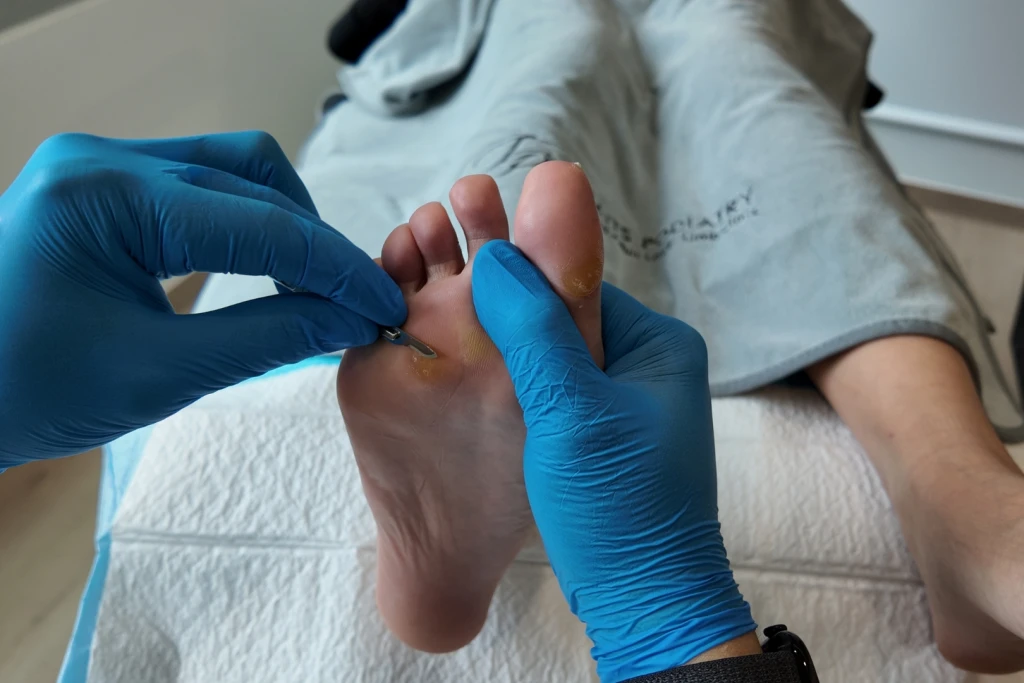
Scalpel debridement does the job it is designed to do. It removes the thickened skin and the compacted core cleanly, which gives immediate relief from the pinpoint pain. For someone who has been limping on a hard corn for weeks, that relief matters.
What it does not do is change the mechanics. The foot still has the same shape, the same toe alignment, the same gait pattern, and the same shoe pressing on the same spot. If those inputs do not change, the corn will rebuild. The same logic applies to foot calluses, which form under broader pressure areas through the same mechanism.
Patients sometimes ask whether more aggressive removal would solve the problem. Cutting deeper does not reduce recurrence; it leaves a more vulnerable bed of skin and risks bleeding or infection. The answer is not to remove more skin. It is to remove the pressure.
The 4 Footwear Changes That Actually Stop Recurrence
Most corn recurrence I see can be traced back to a shoe choice. Four changes do more than anything else to break the cycle.
- Wider toe box. If the corn sits on the top, side, or between the toes, the toe box is almost always too narrow. A rounded or square front lets the toes sit without rubbing. A lot of Singaporeans develop interdigital corns from fashionable narrow-front work shoes.
- Length and depth. A shoe half a size too short pushes the toes against the front, and a shoe too shallow rubs the tops of the toe joints (hammertoe-prone feet feel this immediately). When you stand at the end of the day, your longest toe should still have a thumb-width of room.
- Secure midfoot fastening. Slip-on shoes and loose laces let the foot slide forward with every step, driving the same toe into the same edge of the shoe. Laces, straps, or a secure heel counter keep the foot back where it should sit.
- Softer upper, firmer base. A leather or stretchy mesh upper that yields around a bony prominence stops localised rubbing on top of the foot, while a supportive midsole stops the ball of the foot from collapsing into a high-pressure zone.
These are not glamorous changes. They are also the ones that, in my experience, stop the corn coming back.
When Custom Offloading Is Worth It (and When Padding Is Enough)
For a corn that sits on a soft tissue area or between toes, a simple over-the-counter solution can be sufficient. Silicone toe sleeves, gel separators, or a soft adhesive felt pad can redistribute the rubbing away from the corn. Combined with a corrected shoe, these are often enough for corns linked to friction rather than deep mechanical overload.
For a corn that keeps rebuilding under the ball of the foot, on a prominent metatarsal head, or on a hammertoe joint that does not straighten on its own, off-the-shelf padding has a ceiling. The pressure is being generated by foot structure, and only a device that changes how load travels through the foot will change the outcome. This is where custom foot orthotics earn their place. A custom insole is contoured to your foot shape and built with offloading geometry directly under the corn site, so the load is spread to surrounding tissue that can tolerate it.
The decision point is whether the corn keeps returning despite footwear changes and basic padding. If it does, structure is driving the recurrence, and the device needs to address that structure.
What I See Most Often in Clinic
In clinic I see the same conversation almost every week. A patient sits down, frustrated, and says some version of "I had the corn removed three months ago, and it's back already." When I ask what changed after the removal, the answer is usually nothing. The corn was treated as a skin issue, so when the skin was clear, the case felt closed.
What I look at next is the shoe they walked in with. Most of the time, the shoe is the culprit, and the patient is surprised to hear it. The shoe is comfortable, has been worn for years, cost a lot of money. None of that prevents it from being the wrong shape for the foot. The second thing I look at is whether there is a fixed structural factor (a hammertoe, a prominent metatarsal head, a bunion shifting load across the forefoot), because that changes whether we use padding, a custom device, or both.
A returning corn is information. It is the foot telling you that one square centimetre of skin is taking more load than it can tolerate. Changing the input is the only way the corn stops coming back.
If your foot corn keeps returning despite removal, the next step is not another scalpel. It is an assessment of why that spot keeps loading harder than the rest of your foot, and a plan to redistribute that load. Read more about how we approach foot corns and the role of custom foot orthotics, or see a podiatrist at one of our three Singapore clinics for an assessment.