
You spot something on the sole of your foot. It is rough, sore when pressed, and was not there a few weeks ago. The instinct is to search online, but the search only works if you already know what to call it. A lump on the sole can be one of three different conditions that all look similar at first glance.
You can usually narrow it down in under a minute using three quick tests. None of them replace a proper assessment, but they help you decide how urgently to act.
The 3 Things That Look Similar But Are Completely Different
Plantar warts, corns, and calluses all show up as rough, thickened, sometimes painful patches on the sole. That is where the similarity ends.
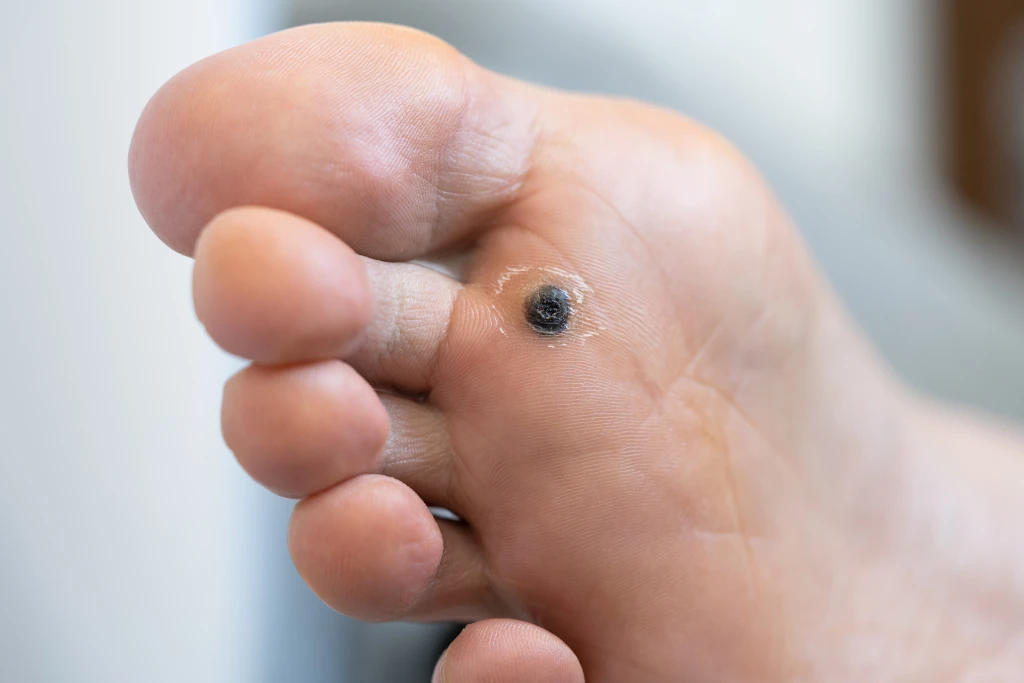
- A plantar wart is a skin infection caused by the human papillomavirus (HPV). It settles into the outer skin layer and forms a small, well-defined lesion that often has tiny black pinpoints inside. Warts appear anywhere on the sole and tend to persist or spread until treated.
- A corn is a small, dense, cone-shaped patch of hardened skin. It forms over focused pressure points, usually on or between the toes or over a bony prominence. The tip of the cone presses inward and can become genuinely painful.
- A callus is a broader, flatter area of thickened skin that forms in response to repeated, spread-out pressure. It is the body's adaptation to load, common across the heel, ball of the foot, or side of the big toe. Pain is rarely sharp, but a deep callus can crack on the heel.
Three different causes, three different treatment paths. Mistaking one for another is the most common reason home remedies fail. A wart pad will not help a callus, and filing a wart at home can spread it.
The Black-Dot Test (and What It Actually Means)
The fastest test is to look closely at the lesion in good light. Use your phone torch if needed.
- Wash and dry the foot, then gently buff away any obvious thick skin on the surface. Stop the moment the skin underneath looks pink or feels tender.
- Look at the centre of the lesion for tiny black or dark brown pinpoints, sometimes called "wart seeds".
- Note whether the lesion has a clearly defined border or blends smoothly into the surrounding skin.
Those black dots are not dirt. They are small clotted capillaries inside the wart tissue. If you see them, the lesion is very likely a plantar wart, and home filing is the worst thing you can do because it risks spreading the virus to nearby skin.
A corn under good light looks more like a small, glassy, pale yellow plug set into a clean ring of hardened skin. No black dots inside.
A callus has no central plug and no pinpoints. It is a uniform sheet of thickened skin that fades gradually into normal skin at the edges.
If the lesion has been picked at or bleeds easily, hold the diagnosis loosely and book an assessment.
The Location Test (Sole vs Pressure Point vs Friction Point)
Where the lesion sits is the second clue, and it often confirms what the black-dot test suggested.
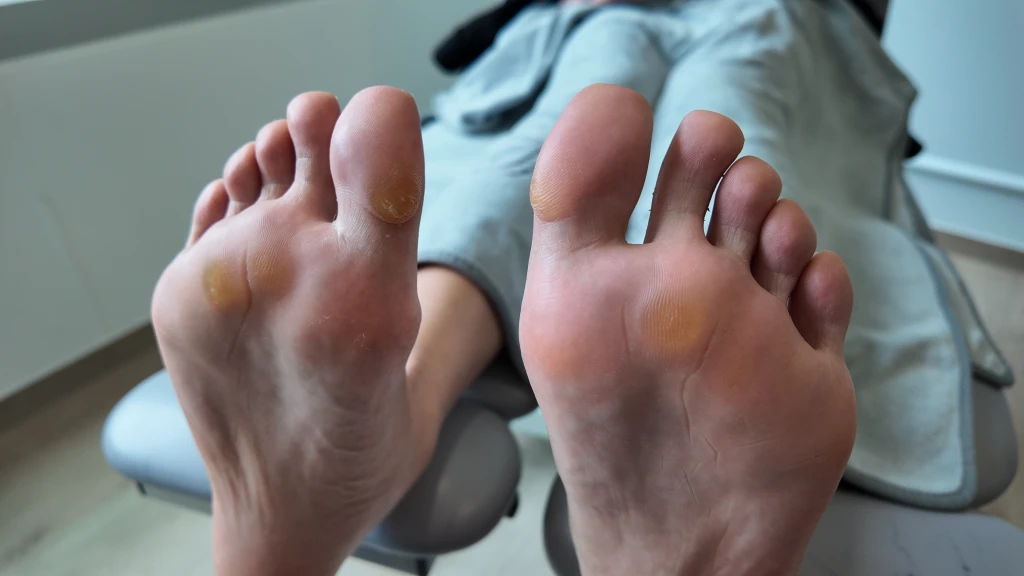
- Stand barefoot on a hard floor and notice where your weight is going. The heel and ball of the foot take the most load.
- Look at the lesion's position relative to those weight-bearing zones and your toes.
- Check whether the same spot lines up with any pressure point inside your usual shoe.
Plantar warts appear anywhere on the sole, including places that take little load. A wart on the arch, well away from any pressure zone, is a telling sign because corns and calluses rarely form without mechanical demand.
Corns sit at specific pressure points. Hard corns appear on top of the toes, over a knuckle, or on the outer edge of the little toe. Soft corns appear between the toes, usually between the fourth and fifth, where moisture and pressure soften the skin. A lesion tucked between two toes is almost always a corn, not a wart.
Calluses spread across friction and load zones: the heel, the ball of the foot under the second and third toes, and the side of the big toe joint. The skin thickens across a wider area rather than forming a sharp central point.
The Pain-Pattern Test (Sharp Under Pressure vs Throbbing vs Constant)
The way a lesion hurts tells you a lot about what is causing it. Try three things, in this order.
- Press the lesion straight down with your thumb.
- Pinch it gently from the sides, squeezing inward.
- Walk a few steps barefoot on a hard floor and notice when the discomfort peaks.
Plantar warts are typically more painful when squeezed from the sides than when pressed straight down. The pinch test is the quick screen most podiatrists use. Warts also tend to give a sharp, oddly specific point of pain when you step on them, like a small stone trapped in the shoe.
Corns hurt most when pressed directly down, because the hardened cone drives into the soft tissue underneath. The pain is focused, often described as a deep bruise under a specific spot, and eases when pressure is removed.
Calluses rarely produce sharp pain. Discomfort tends to be a duller ache or a burning sensation after long periods on the feet. The exception is a deep heel callus that has cracked, which can sting and bleed once a fissure forms.
If the pain pattern does not fit any of these, or if the lesion changes shape or colour quickly, do not keep guessing. Persistent or unusual skin lesions on the foot deserve an in-person assessment.
What to Do Once You've Narrowed It Down
The three tests will usually point you towards a working answer. From there, the next step depends on what you found and how much it is affecting daily walking.
If you suspect a plantar wart, avoid filing or picking at it. Cover it during exercise or in shared wet areas to limit spread, and book an assessment. Home wart pads can help small superficial warts, but stubborn or recurring lesions usually need targeted treatment such as cryotherapy, debridement with topical salicylic acid, or wart needling.
If you suspect a corn, the priority is figuring out what is pressing on that spot. A wider toe box, padding to offload the pressure point, or a small change in walking pattern often helps. The hardened tissue can be reduced in clinic and the underlying mechanics addressed so the corn does not return.
If you suspect a callus, treat it as feedback about where your load is going. A gentle pumice routine, a urea-based cream, and well-fitting shoes keep most calluses comfortable. Painful, cracked, or rapidly recurring calluses are worth assessing, especially with diabetes or reduced sensation, because they can mask early skin breakdown.
When the diagnosis is unclear, when home measures are not helping, or when the same lesion keeps returning to the same spot, that is the cue to see a podiatrist. A short assessment usually resolves the question quickly.