
A lot of people walk into my clinic already certain they need custom orthotics, sometimes before I have even had a proper look at their feet. Usually a friend told them, or a shoe shop did, and a fair number have already bought a pair of “custom” insoles off a shelf that did nothing for them. They arrive expecting me to make the version that finally works.
Here is the honest part. When I actually examine them, many have no real biomechanical problem driving their pain at all. So the fair question is not “which orthotic should I get”, it is “do I even need one”, and after that, “do they actually work”. Both deserve a straight answer, because custom orthotics are genuinely useful in the right situation and a waste of money in the wrong one.
So here is how I talk it through with my patients, roughly in the order the questions come up.
Do custom orthotics actually work?
Yes, but only when they are designed to change the specific mechanics or pressure that is causing your problem. That is the whole point of a custom device. It is not a comfort accessory, it is a tool built to a diagnosis. There is no evidence that arch support is needed for a foot to walk normally, and most people function perfectly well without any insole at all. So we do not offer custom orthotics to everyone who walks in. We offer them when there is a genuine foot or lower limb problem, and the orthotic is designed to address the root cause of that problem, not just to fill the arch.
Then why didn’t the ones I bought help?
Off-the-shelf insoles can help with comfort, especially if all you really needed was a bit of cushioning. But it depends heavily on which one you buy. Some are shaped in ways that do not match real foot anatomy, some are too rigid and push on the wrong part of the foot, and that is exactly why some people end up more uncomfortable than when they started. That is also the real difference between retail and custom insoles, and it is worth knowing that the words orthotics, insoles and shoe inserts are not interchangeable.
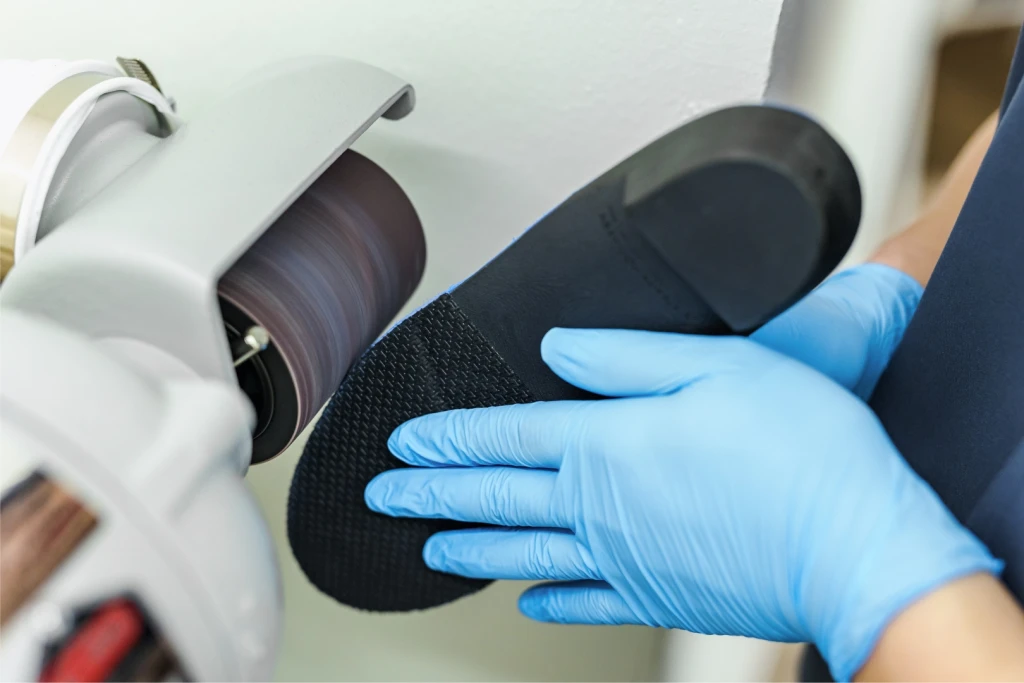
A true custom orthotic is not just a mould of your foot. It is built around angles that change the position of your joints, so the foot is realigned and the pressure is redistributed. Done well, it changes your foot posture, which matters most in a flat foot, rather than simply jamming up the arch and causing pain.
I can tell you this from my own feet, not just from across the clinic desk. I have flat feet myself, and I have worn custom orthotics since I was a teenager. Over the years, I have tried more than ten different designs on my own feet, from the very first pair a podiatrist made for me to the ones I design now. That taught me something no textbook can. A custom orthotic that controls a flat foot and still feels comfortable is genuinely hard to get right, and an orthotic that looks correct on paper but feels wrong is a common problem. It is also why, when a patient tells me their orthotic does not feel right, I know exactly what they mean, and I can usually put it right.
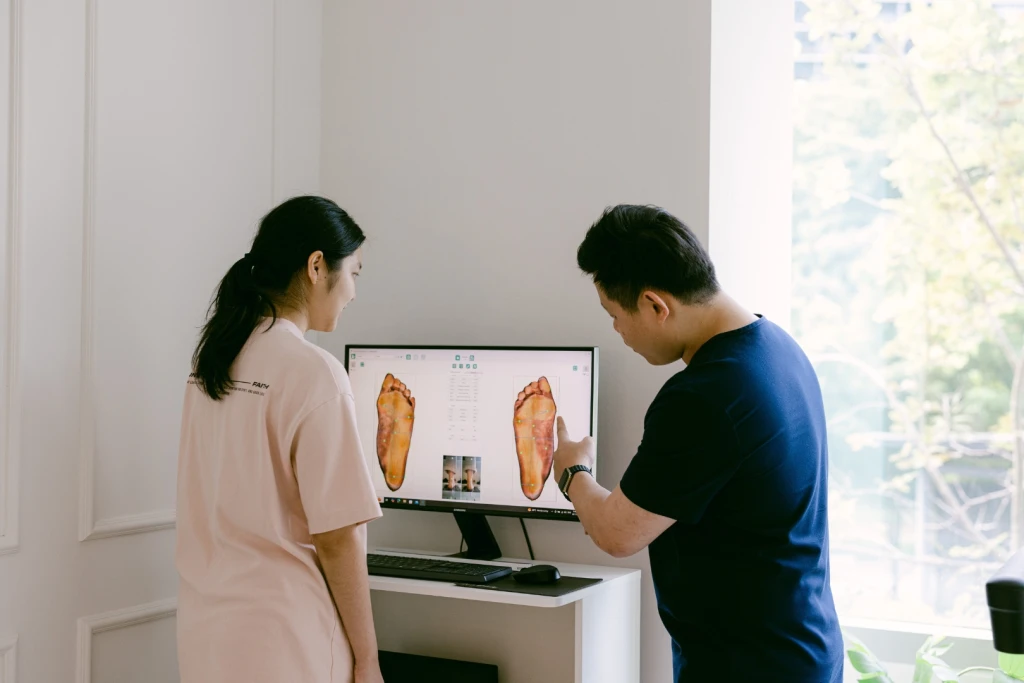
Do I even need one? I only have heel pain.
This one comes up a lot. Someone arrives with heel pain, sure that an orthotic is the fix, because that is what they were told. But when I examine them, the heel pain is not being driven by their foot structure at all. Sometimes it is a poor choice of footwear. Sometimes it is a jump in activity without building up to it gradually. Sometimes it is simply a very tight calf or tight hamstrings pulling on the chain.
Finding that driver matters far more than handing over an orthotic. So in my practice we look for what is actually causing the heel pain and target that, whether it is a stretching regime, a loading programme, or a properly structured exercise plan. If an orthotic turns out to be part of the answer, good. If it is not, you have saved yourself a lot of money.
Will custom orthotics make my feet weak or dependent?
This is the myth I most want to clear up, because it is half true and half wrong, and the difference matters. You may have seen it claimed that orthotics make your feet weak or “dependent”. There is a real study behind that idea. Researchers put young adults with flat feet in custom orthoses for twelve weeks and measured the small muscles inside the foot (the intrinsic foot muscles). Those muscles did shrink in size. The abductor hallucis, a muscle that helps support the arch, dropped the most, by around seventeen percent.
So is that proof that orthotics weaken your feet? Not quite. The study measured the size of the muscle, not its strength, and not how well the foot worked. A smaller muscle on a scan is not the same as a weaker or worse-functioning foot, and the study never tested walking performance at all. The muscle activity did not even change. The most likely explanation is simply that the orthotic shares some of the load, so over twelve weeks the muscle does a little less and gets a little smaller, the same way any muscle does when it is offloaded.
Here is the sensible takeaway, and it is the one the researchers themselves reached. Do not rely on the orthotics and forget to keep your feet strong. That is exactly how we use them. We would never tell you that an orthotic replaces the need for exercises. Where an orthotic is the right call, it goes alongside a plan to keep your foot working, not in place of one.
When is a custom orthotic genuinely worth it?
So who does benefit. The clearest cases are the ones where your structure is doing work that no shoe or shelf insole can fix, a genuine flat foot, a high arch, or a leg length difference that is throwing off how you load. In those situations a custom orthotic that is designed to your foot, and to your diagnosis, can change your foot posture and take the strain off the tissue that is complaining, whether that is plantar fasciitis or something further up the leg.
The key word is designed. A good orthotic is built to a reason. If nobody can tell you the reason, you probably do not need one.
So, do you need custom orthotics?
To pull it together. Custom orthotics work when they are solving a real mechanical problem, and they are a waste of money when they are not. They are not for everyone. A good one is designed to your diagnosis, and it belongs alongside a plan to keep your foot strong rather than in place of one. The value was never in the plastic, it was in the assessment that tells you whether you need it and what it should be doing.
If you have foot or heel pain that is not settling, the useful first step is not to buy an orthotic, it is to find out what is driving it. If you would like that worked out properly, book a consultation with any of our podiatrists in Singapore at any of our three locations, and we will tell you honestly whether an orthotic is part of your answer or not.
Reference: The effect of a 12-week custom foot orthotic intervention on muscle size and muscle activity of the intrinsic foot muscle of young adults during gait termination. Clinical Biomechanics, 2020. Twelve weeks of custom foot orthoses reduced the size of the intrinsic foot muscles, with the largest reduction in abductor hallucis, and no change in muscle activity.