

Every so often, a patient comes in for stubborn knee pain; we get to the bottom of it, and somewhere in the conversation they mention, almost as an afterthought, that someone once told them their flat feet might be involved. They had brushed it away as unlikely. More often than the other way around, though, it is the flat foot that has quietly been driving the problem the whole time.
I will say upfront that flat feet are a more common cause of pain further up the body than most people realise, but they are not the cause of every knee, hip, or back pain, and I never assume they are. I have a personal stake in this too. I have had flat feet since my teens, and when my training load jumped during National Service, it was my knees that complained first, later diagnosed as chondromalacia and a meniscus issue. So here is how a low arch actually affects the rest of you, what the evidence really says, and how I work out whether your foot is the culprit or just an innocent bystander.
Can flat feet really cause pain in your knee, hip, or back?
Yes, and it is more common than people give it credit for. The patients who are more tuned in come to us early and ask for an assessment. Far more people, though, keep blaming the pain on the activity they do, the shoes they wear, or simply their age. The real cost of that is not just the delay. Many of them quietly give up on exercise because it hurts, and the muscles that were helping to hold everything in line then weaken, and that adds to the problem rather than easing it.
At the same time, I genuinely see the other version, the patient who comes in for a knee issue and only mentions in passing that a previous clinician linked it to their flat feet. Sometimes that link is real, and sometimes it is a coincidence. How I decide comes down to the diagnosis itself: what exactly is causing the pain, whether that specific condition has a genuine association with flat feet, and whether other factors are contributing. The foot posture being flat is never enough on its own to call it the cause.
How a collapsed arch travels up the body
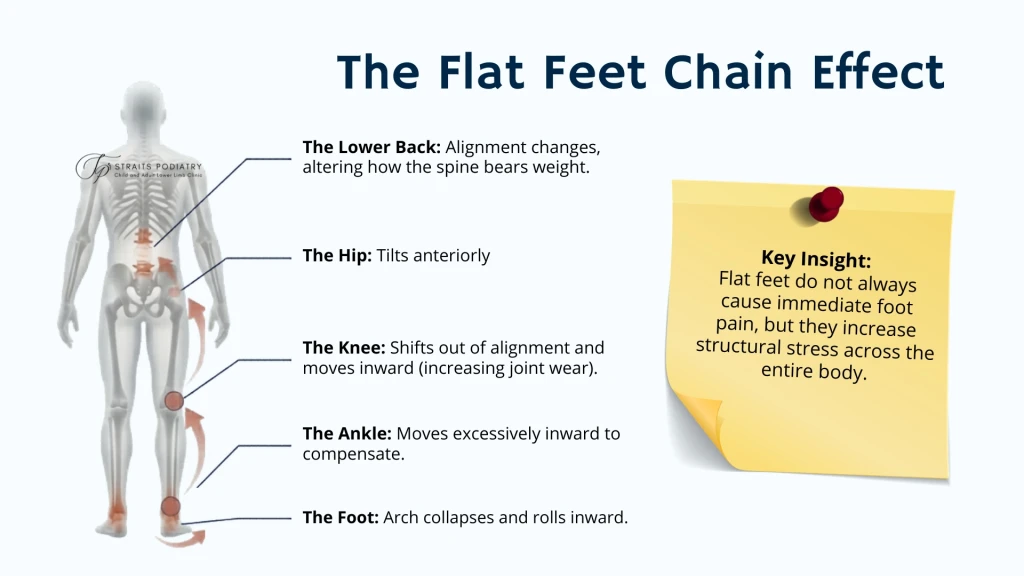
The problem with a collapsed arch is not really the height of the arch. It is the excessive pronation that comes with it. Pronation is not a simple heel tilt or an arch dropping. It is a motion in three planes at once, combining eversion, abduction, and dorsiflexion, so it is ultimately a rotational movement of the foot.
Here is why that matters higher up. When you are standing, your body weight anchors your foot against the ground, and that closes what we call the kinetic chain. One joint’s motion then drives the next, a bit like gears meshing together. So the excessive pronation at the foot pulls the tibia (the shin bone) into internal rotation, and that internal rotation carries up to the femur (the thigh bone), which in turn tips the pelvis forward into an anterior tilt and changes the alignment of the lower spine.
Researchers have measured exactly this chain: adding just a few degrees of foot pronation produced internal rotation of the shank and thigh and a measurable increase in anterior pelvic tilt, with the shank acting as the link that passes the motion upward. [1] Each of these small rotations changes how the muscles of the lower limb have to work and where tissue stress lands, which is where the aches begin.
Worth being honest about: that study created the pronation artificially with wedges to isolate the mechanism, so it shows the chain is real, not that every flat foot will inevitably give you back pain. Which brings us to what the evidence actually supports.
What the evidence says, and where clinical judgement takes over
If you asked me everything flat feet are associated with, it could fill a textbook. What matters is the framing. Flat feet increase the risk of developing certain injuries, but that risk does not land on everyone. A large review of foot posture as a risk factor found that a pronated, flatter foot was linked to patellofemoral (kneecap) pain and to shin splints, but the effect was small, and the evidence was mixed across other conditions. [2] That is a fair reflection of what I see in clinic.
Pain, more often than not, is the product of several things stacked together: foot posture, load, age, footwear, and the way you train. So when I assess, I do not leap from “you have flat feet and you have pain” to “the foot is entirely to blame.” I look at the whole picture before I am willing to call it a proven cause. But equally, if there has been no meaningful change in activity or any other obvious driver, then the foot posture becomes the most likely explanation.
This is also the answer to the question almost every flat-footed patient asks me: why does it hurt now, when I have had flat feet all my life? The reason is that your tissues tolerate load better when you are younger. The same foot posture asks for the same tissue tolerance as you get older, and when that tolerance drops, the structure that coped for decades starts to complain.
How I tell whether your foot is the real cause
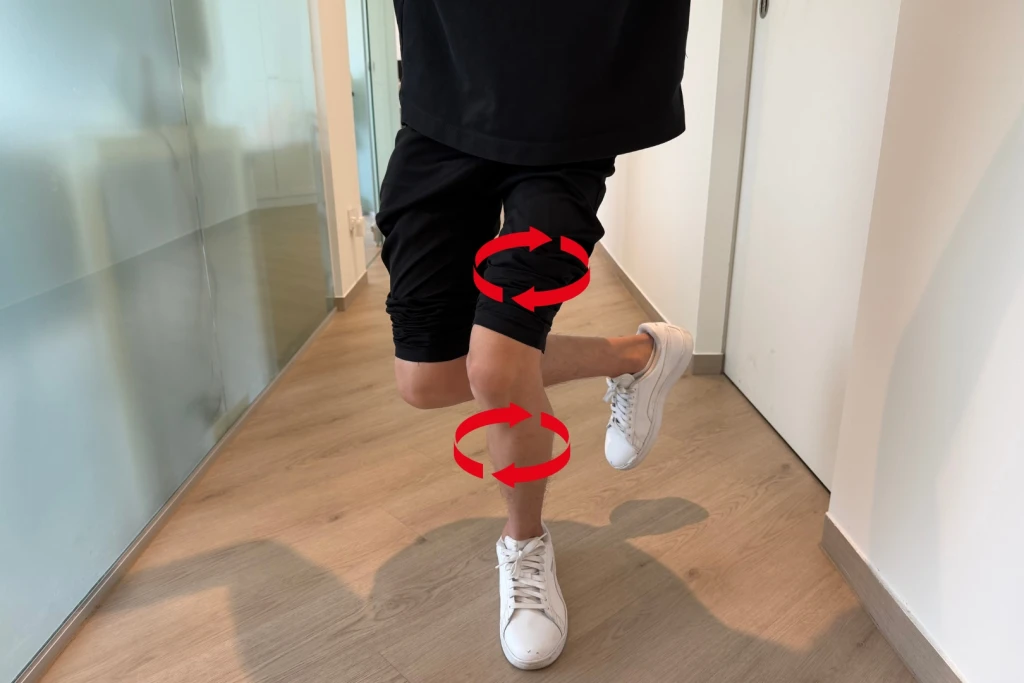
This is where a physical assessment does the heavy lifting, because you cannot judge it from a static photo of a flat foot. I start with the foot posture itself, how collapsed or pronated it is, and then compare that to what happens during gait analysis: does the pronation get worse when you actually walk? From there, I work up the chain. Is the iliotibial band or the outer quad overly fatigued from working to counter the internal rotation of the leg? Does the pronation or the inward collapse worsen during a single-leg squat? Is the lateral calf noticeably tight, which accentuates the pronation further? How does the hip sit and behave during walking? The answers tell me how much of a role the flat foot is genuinely playing in the pain above it.
The conditions where I most often trace the root cause back to a flat foot are patellofemoral pain syndrome, also called chondromalacia patellae, greater trochanteric pain syndrome on the outer hip, and sacroiliac joint pain in the lower back. Those are the patterns that make me look down at the feet, not just at the painful joint.
Why treating the foot is different from treating the painful joint
When the flat foot really is the driver, treating only the sore knee, hip, or back misses the point. We have to manage what the flat foot is doing during gait, which in plain terms means reducing the excessive pronation. Notice I said reduce, not eliminate. Pronation is a necessary motion that helps absorb shock with every step, so the goal is never to lock the foot rigid. It is to stop it collapsing all the way through.
This is where a carefully designed pair of customised insoles for flat feet comes in. Every flat foot is different, and each has its own subtalar joint axis, the line that determines which part of the foot can be supinated and which cannot. If someone simply tells you to “get arch support,” that is a frustrating oversimplification when it comes to insoles for flat feet. I know exactly how a generic arch support feels on my own flat feet, and the honest answer is that it just hurts. Once the pronation is genuinely brought under control, we can build on it with muscular strengthening, and that combination is often what brings a meaningful change, letting people walk or run longer, or get through a holiday on their feet without the pain flaring.
The misconceptions I correct most
Top of the list are those videos telling people to walk around consciously holding their arch up, promising it will fix their knee and hip pain. Flat feet are not a lazy habit. Nobody needs to walk that self-consciously, and honestly, the moment you are absorbed in anything, you will fall straight back to walking normally. It does not work.
The second is the belief that fixing the arch will automatically cure the pain above it. It will not always, because the diagnosis is what matters. You have to be confident the foot is truly the driver before you can tell someone that is where the fix lives. And even when it is, the foot is rarely the only thing to address. Strength, footwear, and how you manage training load all still have a part to play. That is exactly why an assessment comes first, and a blanket “it’s your flat feet” comes never.
Have your feet, and the joints above them, assessed
If you have nagging knee, hip, or lower back pain and a low arch, it is worth finding out whether the two are connected before you spend months treating the wrong end of the chain. Book a consultation with any of our podiatrists in Singapore for an assessment of your feet, your gait, and how load is really travelling up your body, along with honest advice on what will and will not help.
Frequently Asked Questions About Flat Feet and Joint Pain
Can flat feet cause knee pain even if my feet don’t hurt?
Yes. A flat foot can change how load and rotation travel up the leg without the foot itself being sore, so the first place you feel it is sometimes the knee, hip, or lower back rather than the arch. This is common, which is why a painless flat foot is still worth assessing when pain appears higher up. Whether the foot is genuinely the driver depends on the diagnosis and what the rest of the assessment shows.
Will insoles fix my knee, hip, or back pain?
Only if the flat foot is actually contributing to it. When it is, customised insoles that reduce the excessive pronation can take real strain off the joints above, and they work best paired with strengthening and sensible footwear. When the foot is not the driver, insoles alone will not solve the pain, which is why an assessment to confirm the cause comes before any insole.
Do I need custom insoles, or will an over-the-counter arch support do?
For a symptomatic flat foot driving pain up the chain, a generic arch support is often too simplistic and can even feel uncomfortable, because every flat foot has a different subtalar joint axis. Customised insoles are designed around your specific foot mechanics rather than a one-shape-fits-all arch, so they can control the pronation without simply propping up the arch and hoping.
How do I know if my flat feet are the cause of my pain?
It takes a physical assessment rather than a glance at a flat arch. A podiatrist looks at how much the foot pronates in standing and during walking, whether it worsens on a single-leg squat, how tight the lateral calf is, and how the knee and hip behave through your gait, then weighs that against your actual diagnosis and other factors like load and footwear. That is what separates a flat foot that is truly the cause from one that is just along for the ride.
References
- Khamis S, Yizhar Z. Effect of feet hyperpronation on pelvic alignment in a standing position. Gait Posture. 2007;25(1):127-134. doi:10.1016/j.gaitpost.2006.02.005.
- Neal BS, Griffiths IB, Dowling GJ, et al. Foot posture as a risk factor for lower limb overuse injury: a systematic review and meta-analysis. J Foot Ankle Res. 2014;7(1):55. doi:10.1186/s13047-014-0055-4.