
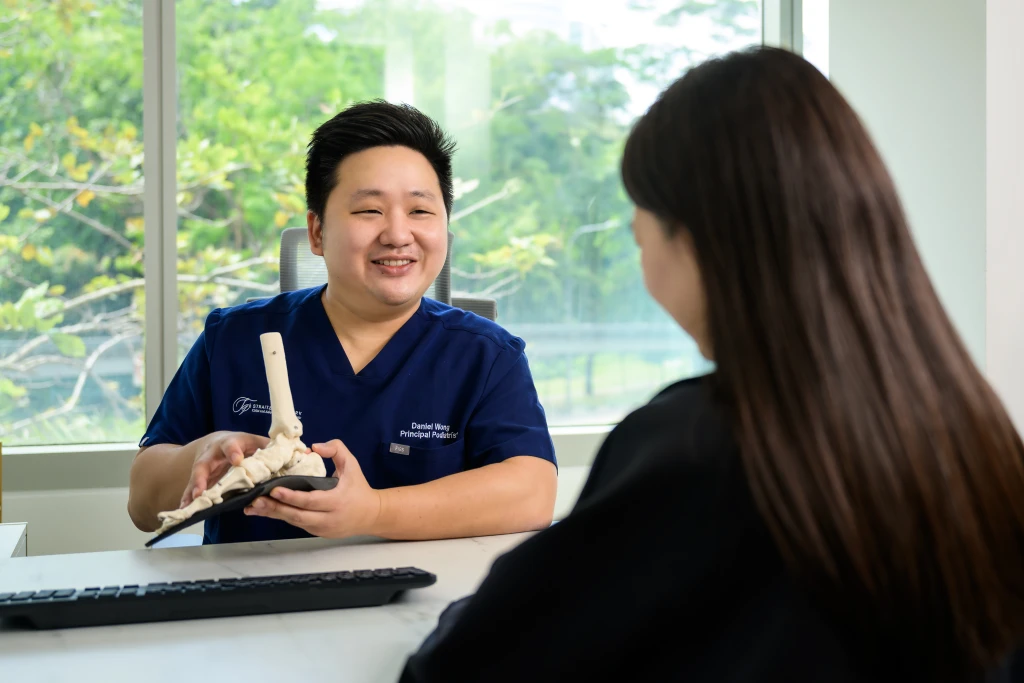
“Foot doctor” is not a Singapore medical title. People search for it because they want help with a foot problem and are not sure whether to look for a podiatrist, an orthopaedic surgeon, or a GP. This article disambiguates the terms, what each role actually trains in, who handles what, and the practical rule of thumb for which one to call first.
If you have been searching “foot doctor near me” and getting a mix of clinics, hospitals, and clinics with very different price points, this is the orientation you needed.
What People Mean When They Say “Foot Doctor”
“Foot doctor” is a colloquial English phrase, not a regulated title in Singapore. When patients use it, they usually mean one of three roles:
- A podiatrist: a clinician trained in foot, ankle, and lower limb conditions, working in private practice or some public hospitals.
- An orthopaedic surgeon with a foot and ankle interest: a medical doctor who has completed a surgical specialty in orthopaedics and may sub-specialise in foot and ankle surgery.
- A GP they trust: the family doctor who handles the first round of any health concern, including foot complaints, before referring on if needed.
These three roles overlap in what they can address at the front door, but diverge significantly in what they actually do behind the door. The choice matters because the cost, the time spent on assessment, and the type of plan you leave with differ.
What a Podiatrist Actually Trains In
A podiatrist’s training is foot, ankle, and lower limb focused from the start. In jurisdictions where podiatry is established (UK, Australia, US), the qualifying pathway is a dedicated podiatry degree that covers:
- Lower limb anatomy and biomechanics in depth.
- Diagnosis of foot, ankle, leg, and related lower-limb conditions.
- Non-surgical conservative care: load management, footwear, exercise prescription, orthoses, taping, nail and skin work, regenerative therapies (such as shockwave).
- Minor nail procedures performed under local anaesthetic.
- Recognising when a problem sits outside the scope of conservative care and referring to surgical opinion.
What a podiatrist does not do: open foot or ankle surgery. That sits with orthopaedic surgeons.
The day-to-day work of a podiatrist in Singapore: assessment of foot and lower limb pain, structural and biomechanical conditions, sports overuse injuries, paediatric foot development questions, diabetic foot screening, nail and skin care, and the non-surgical management plan that follows from any of these.

The Practical Difference in Scope
The cleanest way to think about it is what each role is built to do as the primary intervention.
Podiatrist:
- Diagnoses the foot/lower-limb condition and explains the mechanism.
- Builds a conservative care plan: load modification, footwear, exercises, orthoses where appropriate, regenerative therapies such as shockwave.
- Performs nail procedures and skin-condition care in-clinic.
- Refers to orthopaedics if surgery is being considered or if the condition is outside conservative scope.
Orthopaedic surgeon (foot and ankle interest):
- Diagnoses across the full musculoskeletal system, with surgical capability.
- Operates on fractures, severe deformities, ligament reconstructions, joint replacements, and other structural foot/ankle work.
- Often manages post-surgical recovery, sometimes co-managing rehab with a podiatrist or physiotherapist.
GP:
- First-line assessment of any health concern, including foot pain.
- Prescribes basic medication for pain or infection.
- Refers to a podiatrist or orthopaedic surgeon depending on what they find.
The scope difference is real. A patient with heel pain, plantar fasciitis, a flat-foot question, an ingrown toenail, a fungal nail concern, or a sports overuse injury is the natural fit for a podiatrist. A patient with a displaced ankle fracture, a bunion that needs surgical correction, or a torn ligament needing reconstruction is heading for an orthopaedic surgeon.
A Rule of Thumb for Who to Call First
Most foot and lower limb concerns that are not emergencies start with a podiatrist. The reasoning:
- Most foot conditions are conservative-care-amenable. They do not need surgery as the first step.
- A podiatry consultation builds the structural and biomechanical picture in detail, which is the work that has to happen before surgery is on the table anyway.
- If the case turns out to need surgical input, the podiatrist refers on with the assessment already done.
The exceptions where you would skip the podiatrist and head straight to an orthopaedic surgeon (usually via A&E or a GP referral): acute trauma with deformity or inability to bear weight (suspected fracture or dislocation), and known severe deformity where surgical correction is already the planned path.
For everything else, including chronic pain that has not settled, recurring overuse injuries, structural concerns, paediatric foot questions, nail and skin issues, and biomechanical assessments, a podiatry visit is the front door.
When You Do Need an Orthopaedic Surgeon Instead
Specific scenarios where surgical opinion is the right starting point:
- Acute fracture or dislocation with significant deformity. A&E first, orthopaedics from there.
- Failed conservative care: a condition that has been managed conservatively for six to twelve months without adequate improvement and where the mechanical issue is structural in origin (e.g., severe bunion, advanced toe deformity, certain ankle instability cases).
- Conditions where the imaging already shows a structural lesion that conservative care cannot address (e.g., osteochondral defect, certain tendon ruptures).
- Joint replacement consideration in late-stage arthritic disease.
In these cases, a podiatrist will often refer to a specific orthopaedic surgeon they work with, after completing the conservative-care assessment. That referral, with assessment notes, is more efficient than walking into a surgical consultation cold.
Closing
The simple version: in Singapore there is no titled “foot doctor”. For most foot and lower limb concerns that are not acute emergencies, a podiatrist is the right first call. For severe acute trauma or structural conditions that need surgical intervention, an orthopaedic surgeon is the destination, and a podiatrist or GP will help route you there.
If you want a fuller comparison across podiatry, physiotherapy, and orthopaedics for lower limb pain, the podiatry vs physiotherapy vs orthopaedic in Singapore blog covers that ground. For a deeper read on what podiatry actually is, what is podiatry walks through the scope of practice.
When you are ready, you can book a first consultation at any of our three locations across West, Central, and East Singapore.