

The story behind foot and heel pain during National Service is usually the same one. Someone who did not do much running or marching before enlistment is suddenly doing a lot of both, and a few weeks in, their heels, ankles or shins start to complain. At first it is a dull ache after training. Then it is still there the next morning. Then it starts to bite during the run itself.
Most of the time, this is the body telling you that the load has gone up faster than your feet and legs can adapt to. Sometimes it is telling you something more serious. Knowing the difference, and knowing when to keep going and when to stop, is what keeps a training niggle from turning into an injury that takes you out for months. These are the questions I work through with NS men who come in with sore feet, in roughly the order they matter.
The foot and heel pain I see most in National Service
There is a fairly predictable set of injuries that turn up in people going through NS.
- Pain under the heel. This is usually plantar fasciitis, where the thick band of tissue running along the sole from the heel to the toes becomes irritated. It is classically worst with the first few steps in the morning.
- Pain at the back of the heel. This is often Achilles tendonitis, irritation of the big tendon that joins your calf to your heel bone.
- Pain along the inside of the shin. This is usually shin splints, a strain on the bone and the tissue attached to it along the inner edge of the shin.
- Pain on the inside of the ankle. A lot of this is pain in the posterior tibial tendon, the tendon that helps hold up your arch and works hard every time you land.
What they have in common is timing. These problems tend to appear when the training load goes up, whether that is the jump into Basic Military Training, a block of longer route marches, or the push before an IPPT.
Why NS training brings on foot pain so quickly
Your tendons, muscles and bones are all able to get stronger with training, but they need time to do it. If you were fairly sedentary before enlistment, your feet are simply not used to the amount of load they suddenly have to handle.
When that load jumps faster than the tissues can adapt, the stress builds up in the areas taking the most strain. The tendons and muscles are being asked to cope with more than they are conditioned for, and once that stress goes past what they can tolerate, an injury follows. It is not that NS is doing something unusual to your feet. It is that the increase happens all at once, for a whole platoon at the same time.
This is also why two people doing exactly the same training can end up in very different places. The person who ran regularly before enlistment has tissues that are already used to the load. The person who had not run in years is starting from much further back.
Training soreness or a stress fracture? How to tell during NS
This is the question I most want NS men to be able to answer for themselves, because the two need very different responses.
Normal training soreness behaves in a predictable way.
- You may feel a dull, sore sensation in the area during the march or run.
- It starts to ease once you rest after the activity.
- You might still feel some soreness for one to two days afterwards, and then it settles.
A stress fracture behaves differently. A stress fracture is a small crack in the bone from repeated load rather than a single big impact, and in the foot it often affects the long bones in the middle of the foot, a metatarsal stress fracture, or the heel bone, a calcaneal stress fracture.
- You may notice visible changes around the area, such as swelling, redness or a warm, inflamed look.
- The pain is sharp rather than dull.
- It does not get better with rest, and it tends to get progressively worse over the days rather than settling.
- Pressing on one particular spot of the bone is often very tender.
If your pain fits the second pattern, it is not something to train through. Stop and get it assessed.
How to train through foot pain in NS without making it worse
The safest way to train is progressively. You would not go out and run 10km if you have never managed a 2km run without any issues, and your feet work the same way. The training intensity should build up gradually, so your body has a chance to adapt at each step before the next one.
When you are training, the line I would draw is sharp pain.
- Dull soreness that eases with rest is part of adapting. Keep training sensibly.
- Sharp pain during jumping, marching or running is a sign to stop. Rest first, take it easy, and only resume if the sharp pain has gone.
- Sharp pain that keeps coming back or persists means stopping all the aggravating activity and getting it assessed. Within NS, that means reporting sick so the medical officer can take a look.
Going back to full training too quickly after a flare is one of the main reasons shin splints keep coming back, and the same logic applies to the heel and the Achilles. The pain settling is not the same as the tissue being ready for the full load again.
Do insoles and better shoes help with foot pain in National Service?
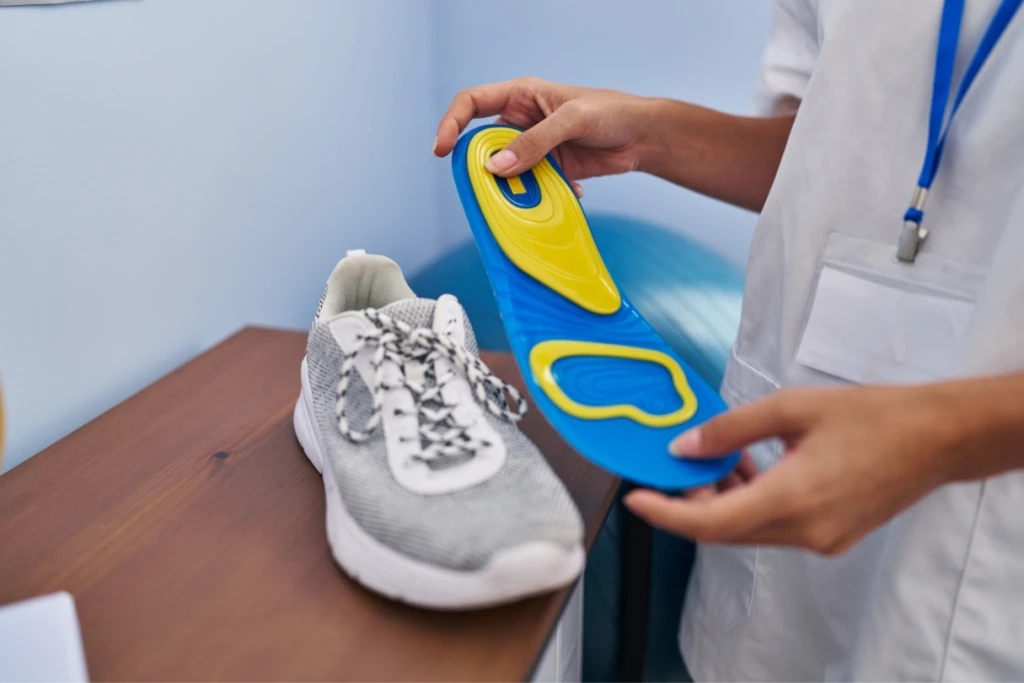
Yes, they generally help. Good footwear and a properly made insole help to redistribute pressure away from the areas that are being overloaded.
Take someone with flat feet who is overloading the inside of the ankle with every step. A custom insole, together with appropriate footwear, reduces the strain on that inner ankle, and that lowers the chance of injury around the area.
I would add one honest caveat. An insole manages the load, it does not replace the gradual build-up of training. If the training jumps too quickly, even a well-supported foot can still get overloaded. The two work together.
The biggest mistake recruits make with foot pain
The mistake I see most is simply putting up with it. When everyone is training together, nobody wants to be the one who looks weak, so recruits tend to endure the pain and only seek help when it has become really quite bad.
That delay matters. Most of these problems respond well to conservative care when they are caught early, with load changes, footwear, insoles and the right exercises. Leave it long enough and the options narrow. An irritated Achilles tendon that is ignored can progress to a rupture, and at that point it is often no longer something conservative care can address, and surgery may be needed. So please do not wait until something gives way before coming in.
What I would do if your feet hurt during NS
If your heels, ankles or shins started hurting a few weeks after your training load went up, the most likely explanation is tissue that has been asked to do more than it was ready for. If the pain is dull and settles with rest, build your training more gradually and keep an eye on it. If it is sharp, swollen, getting worse, or not easing with rest, stop and report sick so it can be assessed, because a stress fracture needs to be ruled out.
When you see a podiatrist, the assessment looks at exactly where the pain sits, how your foot lands and rolls as you walk and run, and whether your foot posture is putting extra load on the area that hurts. From there, the plan usually combines a sensible return to training, footwear advice, and custom insoles where your foot mechanics need them.
If foot or heel pain is getting in the way of your training, book a consultation with any of our podiatrists in Singapore.
Frequently Asked Questions About Foot Pain in National Service
Is it normal for my feet to hurt during BMT?
Some soreness is normal when your training load suddenly goes up. It should feel dull, ease when you rest and settle within one to two days. Pain that is sharp, comes with swelling or redness, or keeps getting worse is not normal training soreness and should be assessed.
How do I know if my foot pain in NS is a stress fracture?
A stress fracture usually causes sharp pain that does not improve with rest and gets worse over time. There may be swelling or redness, and one spot on the bone is often very tender to press. If that sounds like your pain, stop training on it and report sick so it can be checked.
Do I need insoles for National Service?
Not everyone does. Insoles are most useful when your foot posture is adding strain to the area that hurts, for example flat feet overloading the inside of the ankle. A podiatrist assessment tells you whether your foot mechanics are part of the problem, and a custom insole is made for your foot rather than a generic arch shape. Insoles work best alongside a gradual build-up of training, not instead of it.
Can I keep training if my shins or heels are sore?
If the soreness is dull and settles with rest, you can usually keep training while building up more gradually. If the pain is sharp, stop and rest first, and only continue once it has gone. If the sharp pain keeps coming back, stop the activity and get it assessed rather than pushing through.
