

Most foot and lower limb pain can be managed at home for a week or two with rest, ice, and supportive footwear. Some cannot. This article covers the specific red flags that say it is time to stop the home-care approach and book a clinical assessment, pain patterns, swelling profiles, neurological signs, and diabetic-specific warning signs that should not be left to settle on their own.
The aim here is not to make you anxious about every twinge. The aim is to give you a clear filter: if your symptoms fit one of the patterns below, the home-care window has closed and a clinical assessment becomes the next step.
Sharp Pain Patterns That Need Review
Most acute aches will calm down with two weeks of relative rest, supportive shoes, and load reduction. The patterns that do not follow that script are the ones worth flagging.
Book a clinical assessment if any of the following apply:
- Sharp, localised pain that is reproducible on direct pressure over a bone, especially after a recent jump in running or walking volume. This is the pattern associated with bony stress injuries such as a calcaneal stress fracture.
- First-step pain in the morning that has continued past two to three weeks, gets sharper rather than easing across the week, and is still there after rest days. This is the chronic-trajectory pattern for plantar fasciitis and tends to entrench the longer it runs.
- Pain that wakes you up at night, or pain that is present at rest with no load on the foot. Mechanical injuries usually settle when the foot is unloaded. Pain that does not is worth investigating.
- Sudden, severe pain during exercise with an audible pop or snap, followed by inability to push off the foot. This pattern needs same-day review.
The common thread is pain that is not behaving the way an ordinary overload would behave.
Swelling Profiles That Suggest Something Structural
Swelling after a long day on your feet that settles overnight is usually a load issue. Swelling that does not follow that pattern is worth a look.
Flag for review if:
- The swelling is one-sided, has been present for more than a week, and does not reduce with elevation.
- Swelling is accompanied by visible deformity, a step or gap that you can feel along a bone, or an inability to bear weight for more than a few steps.
- There is bruising that has spread beyond the original injury site, or new bruising appearing days after the initial event.
- The swelling is warm and tender and you also feel unwell. This pattern needs same-day medical review rather than a routine podiatry appointment.
Structural swelling profiles do not respond to home care in the way a soft-tissue strain does, and the longer they are left, the harder the underlying issue is to address cleanly.
Neurological Warning Signs
Mechanical pain is one signal. Nerve symptoms are a separate signal that often gets missed because they do not always present as “pain” in the way patients expect.
Book a clinical assessment if you notice any of:
- Persistent numbness or pins and needles in part of the foot, especially if it has been present for more than a few days.
- A patch of skin on the foot that feels different to touch (dulled, distant, or hypersensitive) compared with the same area on the other foot.
- Burning or electric-shock sensations that follow a line down the leg or across the foot.
- Foot drop, where the foot does not lift cleanly during the swing phase of walking and you find yourself catching the toes on the ground or scuffing the shoe tip.
- Loss of balance or a sense that the foot is not “reporting back” to you when standing on uneven ground.
These signs point toward nerve involvement somewhere along the chain (low back, knee, ankle, or local entrapment in the foot). They warrant assessment rather than self-management because the response depends entirely on where the nerve is being affected.
Diabetic-Specific Red Flags
For anyone living with diabetes, the threshold for booking a podiatrist is lower. Reduced sensation and impaired healing mean that issues which would be minor in a non-diabetic foot can escalate quickly.
Book a clinical assessment without delay if you have diabetes and notice:
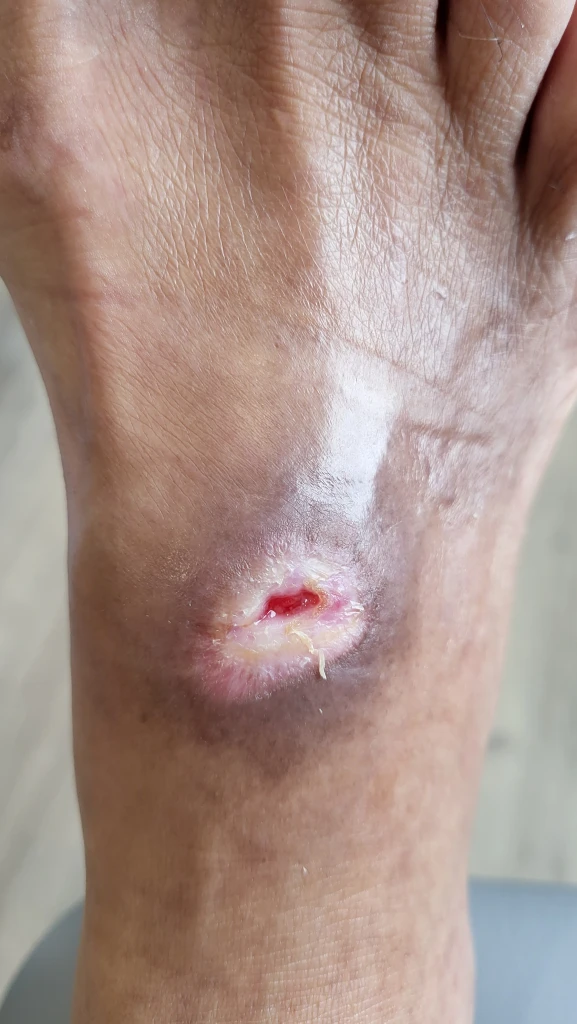
- Any cut, blister, crack, or break in the skin on the foot, regardless of how small. Do not wait to see if it settles.
- A change in skin colour on any part of the foot, including redness, purple discolouration, or pallor.
- A change in temperature, where one foot or one part of a foot feels noticeably warmer or cooler than the surrounding area.
- New numbness, tingling, or a sense that part of the foot has gone “asleep” and not woken back up.
- A change in the shape of the foot, even subtle, such as a new bump, a collapsed arch, or a midfoot that looks different to the other side. This pattern is associated with Charcot foot and needs urgent assessment.
Routine diabetic foot screening is the baseline. Anything that changes between screenings is a reason to bring the next appointment forward.
What “Book This Week” Versus “Go to A&E Today” Looks Like
Not every red flag means the emergency department. Use this rough split:
Go to A&E today if you have:
- Sudden severe pain with inability to bear weight after an obvious injury (suspected fracture or significant ligament rupture).
- Warm, tender, swollen foot with fever or feeling unwell (suspected infection).
- Sudden cold, pale, or blue foot with severe pain (suspected vascular event).
- Open wound on a diabetic foot with surrounding redness or discharge.
Book a podiatrist this week if you have:
- Pain that has not settled after two weeks of sensible self-management.
- Recurring pain that returns whenever you increase activity.
- Neurological symptoms (numbness, tingling, altered sensation) that are not improving.
- Any of the diabetic red flags above with no signs of infection.
- A swelling or deformity pattern that has persisted or progressed.
The split matters because the right setting changes the response. A&E manages acute emergencies. A podiatry clinic works through structural and biomechanical issues across an unhurried assessment and plan.
Don’t Wait for Pain to “Prove Itself”
The pattern we see most often in clinic is not patients overreacting. It is patients who waited months for a problem to prove it was “serious enough” to act on. By then, the soft tissue has remodelled, the loading patterns have shifted, and the rehab runway is longer.
If your symptoms fit any of the red flags above, you can book at any of our three locations across West, Central, and East Singapore. Acting on a clear signal is not overreacting. It is just sensible foot care.