
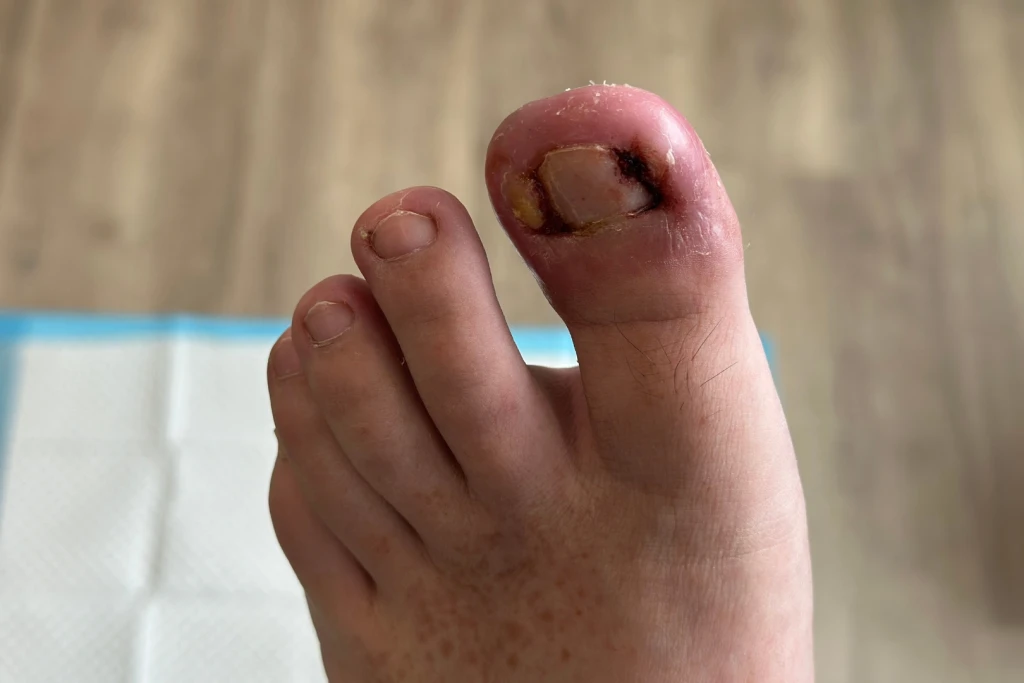
If you have taken one course of antibiotics after another for the same ingrown toenail and it keeps flaring back up, you are not imagining it, and you have not done anything wrong. The reason it keeps returning is almost always the same, and it has very little to do with the antibiotics themselves.
The pattern is so consistent that I see it most weeks in clinic. The toe is painful, red, and swollen, often with a little pus at the corner of the nail. You see a GP, who gives you a course of oral antibiotics and usually an antibiotic cream. And let me guess, it is either a Biotine cream or Fucidin cream. Within a few days the redness, swelling, and pain settle, and it feels like it has finally cleared. Then, one to two weeks later, the pain creeps back, and the pus soon follows. You return to the GP, get another course of antibiotics for the very same toe, and the cycle repeats. By the time many patients reach a podiatrist, the ingrown toenail has been going on for months, and the toe is chronically swollen and discoloured.
Here is the part that is rarely explained: the antibiotics were never treating the actual cause. So this is what I walk my patients through when they are stuck in that loop.
Why do the antibiotics work for a week and then it comes back?
An ingrown toenail is not really a skin infection at heart. It is a spike of nail digging into the flesh beside it, and the body treats that spike the way it treats a splinter. In the medical literature it is described as a foreign body reaction: the skin is inflamed because something sharp is embedded in it and keeps breaking the surface.
Antibiotics knock down the bacteria in that broken skin, which is why the redness and pain settle while you are taking them. But the antibiotics do nothing to the nail spike, and the spike is still there once the course finishes. It is still pressing into the flesh, still opening the skin, so bacteria get back in and the infection returns. That is why relief that comes only from antibiotics tends to be temporary. It is also why studies have found that adding antibiotics does not speed up healing when the offending nail edge is still in place. Nothing finishes until the spike is dealt with.
| Approach | What it targets | What tends to happen |
| A course of antibiotics | The bacteria in the surrounding skin | Redness and pain settle while you take them, then often return within a week or two, because the nail spike is still embedded |
| Removing the offending nail edge | The nail spike itself, the actual cause | The pressure and irritation stop, and the infection usually settles over the following few days, often without antibiotics at all |
So what actually stops it?
Removing the offending edge of nail. In my experience, and regardless of how bad the ingrown toenail looks, once that nail spike is taken out, the pain the patient has been living with, especially when they wear shoes or when the toe is touched, drops significantly straight away. The redness and swelling then follow and settle over the next three to five days. The body can finally clear the infection on its own, because the thing that kept driving it is gone.
That timeline is also a useful check. If the toe does not settle within a few days of the edge being removed, it usually tells me there is still a fragment of nail spike buried in the flesh that needs to be found. This is why having it properly removed matters more than how many antibiotic courses came before it.
Do I need my whole toenail pulled out?
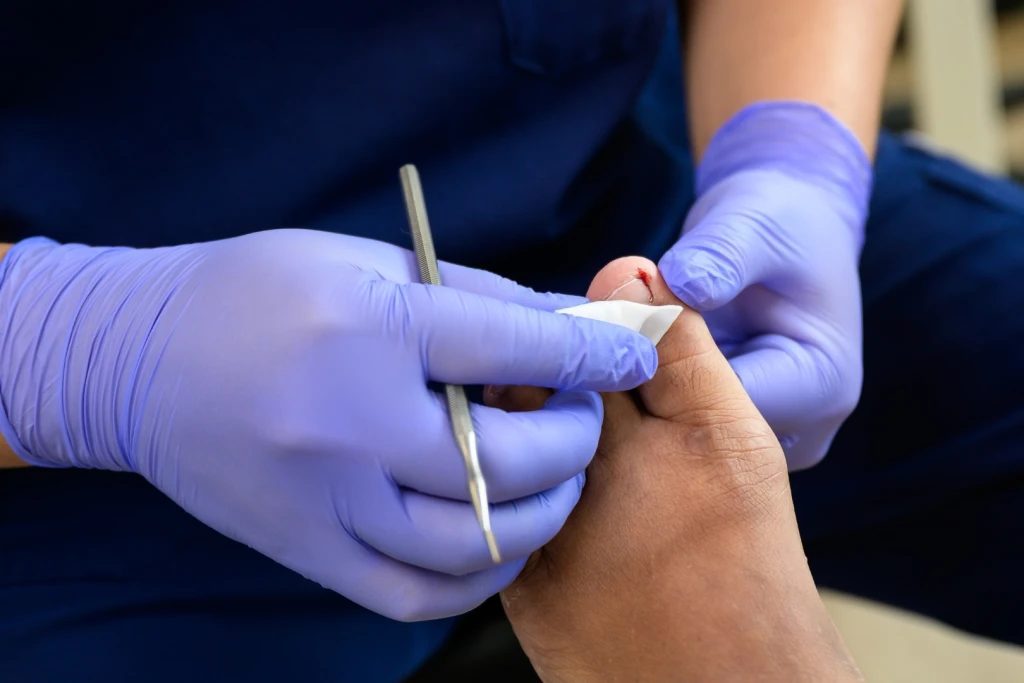
No, and this is the fear that keeps a lot of people applying creams and swallowing antibiotics instead of getting the toe sorted. We hear it often. Pulling the entire nail out is an old and dated approach, and there is no need for it unless an infection has spread right down to the base of the whole nail. In the vast majority of cases, only the thin offending edge is removed, and the rest of your nail is left alone.
The other worry is pain during the procedure. What I can tell you is that we work as gently as possible to keep discomfort to a minimum. Some people have had a rough experience elsewhere, where someone forced a large clipper down the side of the nail or dug around searching for the spike, and that is genuinely painful, but it is not how it should be done. If the toe is already very inflamed, some tenderness is unavoidable, but once the spike is out, the constant pain you have been carrying stops.
Will removing it once be enough, or will it just come back?
For a one-off spike in an otherwise healthy nail, taking that edge out can be all it needs. But when the nail edge is very curved and involuted, or when the same toe keeps getting ingrown again and again, I will usually recommend partial nail avulsion with phenolisation, where a mild chemical is used to stop that specific edge of nail regrowing. Studies report low recurrence rates when the matrix is treated this way, which is the point: it aims to end the problem rather than reset it.
My thinking here is simple. If there is a chance to resolve the issue properly, why leave someone to suffer it over and over. It also gets harder to fix with age. When a person is older or frail, or living with conditions like diabetes, a procedure carries more risk later, such as slower wound healing, and by then the safest options can be off the table. Dealing with it while the risk is low is the kinder path.
One nuance on the non-surgical route. A nail brace such as Onyfix works by attaching to the nail and holding its shape as it grows out, so it needs a flatter nail surface to grip and guide. That means it suits nails that are curved only at the tip. If the nail is curving from the root, a brace is not the option I would recommend, and the choice between bracing and a small procedure is something worth talking through case by case.
So when are antibiotics actually needed?
They do have a genuine place, just not as the whole answer. If a toe turns up already badly infected, with active pus, redness and swelling spreading across the whole toe, a bad smell, or a fever, I will arrange a referral for antibiotics regardless. But even then, the nail spike has to come out first, because the antibiotics cannot settle an infection that is still being fed by the nail. For people who are elderly, going through chemotherapy, or living with diabetes, especially when blood sugar control is borderline or worse, I lean towards referring for antibiotics whenever there are signs of infection, again alongside removing the spike.
For an otherwise healthy person, antibiotics are usually only worth considering if the infection has not improved three days after the spike is removed. Handing out course after course without ever removing the source runs against good antibiotic use, and it leaves the real problem untouched. If you are unsure whether your toe has crossed from irritated into genuinely infected, this is worth reading before deciding what to do next.
What if mine is only mild?
Not every ingrown toenail needs a procedure, and I would not want anyone to think that. If it is mild and the spike is only poking at the very tip of the toe, a careful conservative trim, sometimes called a slant back, is often all it needs. It is the recurring ones, and the nails that curve from the root with a deep spike, that tend to do better with a small procedure, as long as the risk of the procedure is low for that individual.
The part that worries me most
I have seen many toes amputated because of a diabetic foot infection that started as nothing more than an ingrown toenail. Honestly, a lot of those patients would never have reached that point if the nail had been dealt with earlier, before the infection had somewhere to run. That is the real cost of staying in the antibiotic cycle for too long.
So if you keep going back for another course of antibiotics for the same toe, the answer is not a stronger antibiotic. It is having the nail itself looked at. And please have it done by a trained professional such as a podiatrist, with sterile instruments, rather than at a nail salon, because the infection risk is real and not something to gamble with. If your ingrown toenail keeps coming back no matter how many courses you have taken, book a consultation with any of our podiatrists at any of our three clinics in Singapore.
Frequently Asked Questions About Ingrown Toenails and Antibiotics
Can antibiotics cure an ingrown toenail?
Not on their own. Antibiotics treat the bacterial infection in the skin around the nail, but they do not remove the nail spike that is causing it. Once the course finishes, the spike is still embedded, so the infection commonly returns. Removing the offending nail edge is what addresses the cause.
Why does my ingrown toenail keep coming back after antibiotics?
Because the mechanical cause is still there. The embedded nail edge keeps breaking the skin and letting bacteria back in, so each antibiotic course settles things only until it wears off. Repeated infections in the same toe usually mean the nail edge needs to be removed, not re-treated with more antibiotics.
Do I need my whole toenail removed for an ingrown toenail?
Almost never. In most cases only the thin offending edge is removed, and the rest of the nail is left in place. Removing the entire nail is an outdated approach reserved for rare situations where infection involves the whole nail base.
References:
- Ingrown Toenail Management, American Family Physician, 2019.
- Are Antibiotics Necessary in the Treatment of Locally Infected Ingrown Toenails?, Archives of Family Medicine, 2000.