
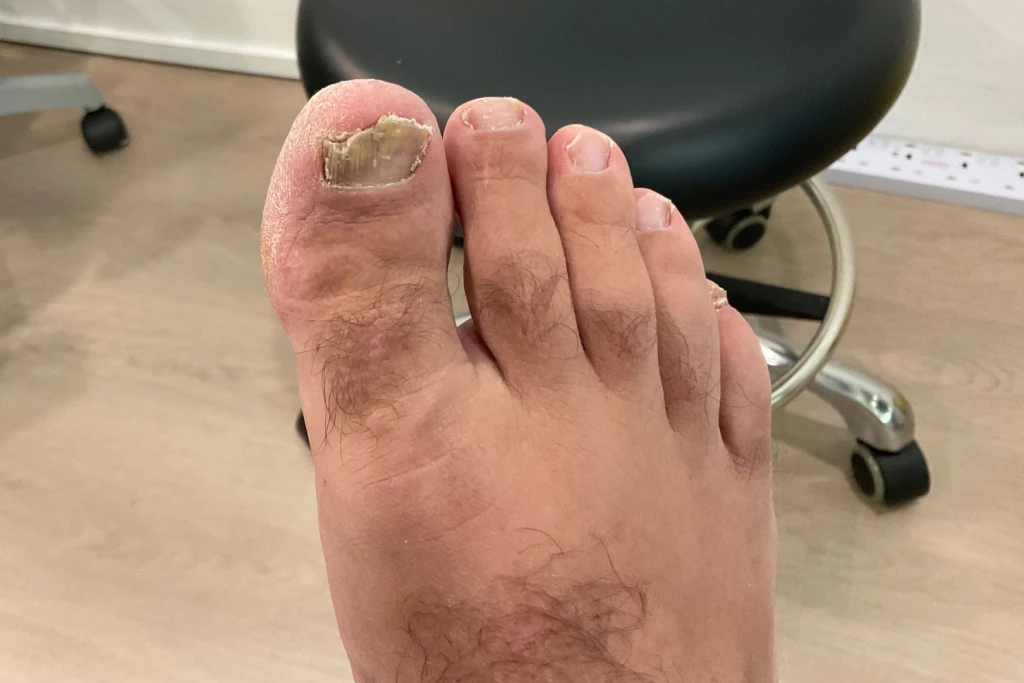
A toenail that smells, or looks like it is slowly rotting, is one of the more common worries I see, and I understand why people find it embarrassing. Patients rarely walk in and say they have an infection. They say the nail smells, or that it looks like it is rotting, or that there is something like cheese trapped underneath. Almost always it is telling a clear clinical story once you know what to look for.
When a toenail genuinely smells, it usually points to an infection rather than poor hygiene. That is normally either bacterial or fungal, and it tends to come with a change in colour, often green, yellow, or brown. Most of the ones I see turn out to be fungal, especially when there is no discharge. The green ones are a different story, and they are worth knowing about, so let me walk through how to read your own nail.
Why does my toenail smell like cheese?
The smell is not the nail itself going off. What I explain to patients is that it is a combination of microorganism growth, moisture and perspiration, and the skin and nail debris that gets trapped underneath the nail. Feet are warm, they sweat, and closed shoes in Singapore’s climate keep everything humid. When fungus or bacteria colonise the space under a nail that is already lifting or thickening, they feed on that trapped keratin debris, and the by-product is the sour, cheesy odour. So the smell is a sign that something is living and multiplying under there, not that you have not washed.
What is the colour of my toenail telling me?
Colour is one of the first things I read, because it narrows down the cause quickly:
| Colour | What it often means |
| Yellow, white, or brown, with thickening and crumbly debris | Most commonly a fungal nail infection, especially when it has crept across the nail slowly and there is no discharge |
| Green, from a streak to the whole nail | Points to a bacterial colonisation, known as green nail syndrome, often under a nail that was already lifted or injured |
| Dark purple, black, or red-brown | Usually old blood from trauma rather than infection, though it should be checked if you cannot recall an injury |
Colour alone does not confirm anything, but it points the assessment in the right direction. A slow, creeping yellow-brown change with powdery debris behaves like a fungal nail. A sudden green tinge under a nail that was knocked behaves like something else entirely.
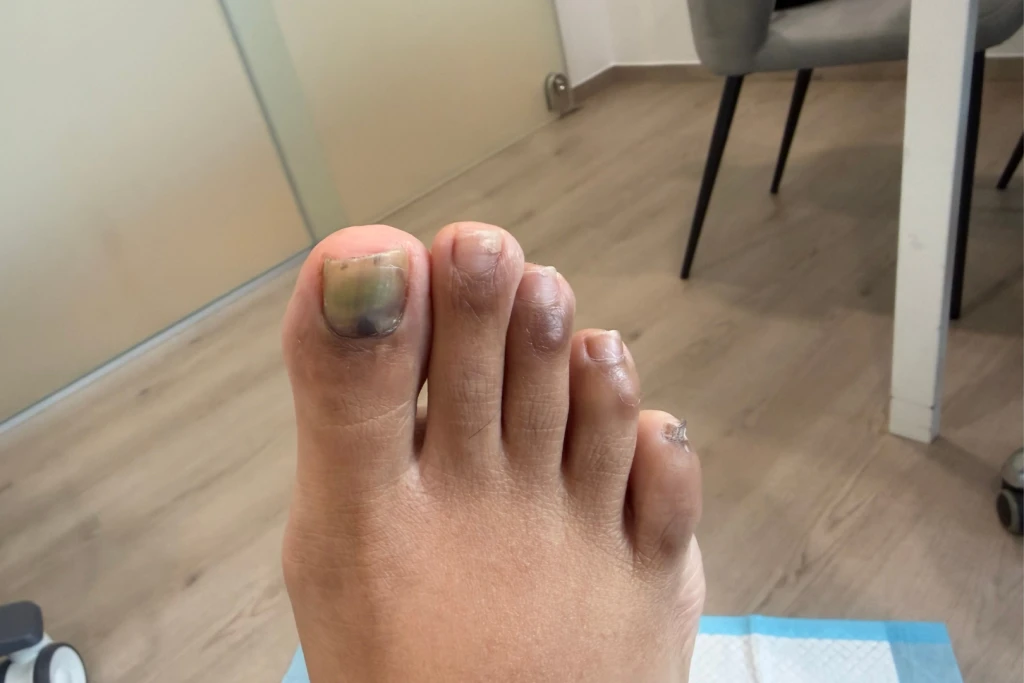
What is the green one? Green nail syndrome
The green nails are the ones people have usually never heard of. This is green nail syndrome, a bacterial colonisation that gives the nail a green tint, anywhere from a streak to the entire plate. There is a pattern I see with it. It often shows up in someone who had a nail injury one to two months earlier, where the nail was already a little loose to begin with. Many of them are active outdoors, at the beach or hiking, so the nail spends time damp. And a fair number of women only notice it after applying gel polish over a nail that had been knocked, because the polish seals the light and moisture against a lifted nail and gives the bacteria a comfortable home.
How it is managed depends largely on how much of the nail plate is affected. The idea is to remove as much of the green, detached nail as possible so the area can dry out and be cleaned, and from there photodynamic antifungal therapy (PACT) can be considered. If the entire nail is discoloured, removing the nail may be needed. Because the bacteria tend to colonise under the nail and on the nail bed surface rather than invade the deeper tissue, oral antibiotics are usually not required, unless there are signs of infection in the surrounding soft tissue. This is also backed by the wider literature, where green nail syndrome is described as a surface colonisation of an already lifted nail, managed first by clearing the detached plate and keeping the area dry.
Why haven’t the pharmacy treatments cleared it?
This is the conversation I have over and over. Over-the-counter paints and creams struggle because they do not get underneath the nail easily, and under the nail is exactly where the infection sits. The nail plate acts like a lid. So people apply a topical faithfully for months, see very little change, and assume the infection is unbeatable, when the real issue is that the treatment never reached the target.
The other thing I find myself repeating is to stop digging. It is tempting to scrape and clear under the nail yourself, or to ask a pedicurist to do it, but that can push debris further in, damage the nail bed, and risk spreading the infection rather than clearing it. Clearing the nail properly is worth doing, but it needs to be done in a way that does not drive the problem deeper.
When should you see a podiatrist?
A smelly or discoloured nail is worth having looked at, partly because the treatment depends entirely on getting the cause right, and partly because not every ugly nail is what it seems. A large share of thick, discoloured nails are not actually fungal, and a green nail is a different problem again, so treating on a guess wastes time and money. In clinic we can read the nail, work out whether it is fungal, bacterial, trauma, or trapped debris, safely clear and thin the nail so any treatment can reach the nail bed, and then talk through the right option. For a confirmed fungal nail, these infections are known to be stubborn, so the earlier the correct call is made, the more straightforward it tends to be.
If your nail smells, is changing colour, or looks like it is rotting, book a consultation with any of our podiatrists at any of our three clinics in Singapore.
Frequently Asked Questions About a Smelly or Discoloured Toenail
Why does my toenail smell so bad?
A genuinely smelly toenail usually means an infection under the nail rather than poor hygiene. The odour comes from microorganisms multiplying in the warm, moist space under the nail, feeding on trapped skin and nail debris. It is most often fungal, and sometimes bacterial, particularly when the nail is also discoloured.
Is my toenail actually rotting?
The nail is not rotting in the way food does, but the description fits what an infection looks like. Fungus or bacteria under the nail make it thicken, crumble, discolour, and smell, which can look like decay. It will not clear on its own, so it is worth having assessed rather than waiting.
What does a green toenail mean?
A green tint, from a streak to the whole nail, usually points to green nail syndrome, a bacterial colonisation of a nail that was already lifted or injured. It is often linked to a past knock and to the nail staying damp. It is generally managed by clearing the detached nail and keeping the area dry, and antibiotics are usually not needed unless the surrounding skin is infected.
Why won’t over-the-counter treatments clear my nail?
Because they struggle to get underneath the nail, which is where the infection lives. The nail plate acts as a barrier, so a topical often sits on top of the problem rather than reaching it. Having the nail safely thinned and cleared first gives any treatment a far better chance of working.
References:
- Green nail: Etiology and treatment of chloronychia, Journal of the American Academy of Dermatology, 2024.