
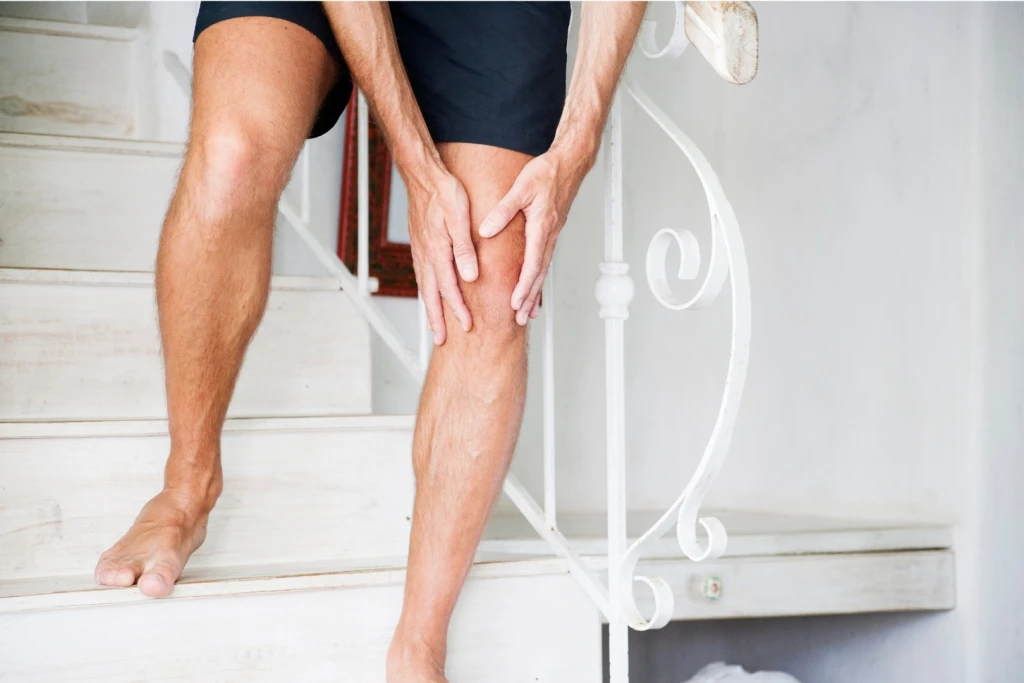
When someone tells me the front of their knee, or a spot deep under the kneecap, bites when they walk down the stairs, I will be honest that my mind goes to runner’s knee first. That is almost jumping to a conclusion, and I know it, but that particular symptom is so commonly linked to it that it is a fair first thought. To be clear, runner’s knee can also mean chondromalacia patellae, and the two terms get used so interchangeably that even clinicians mix them up.
The catch is that this is a symptom, not a diagnosis. Before I settle on anything, I want to know what other activities or movements bring on the same pain, how long it has been building, whether it came on suddenly or after a recent knock, and whether you have picked up a new activity or ramped your training up sharply in a short space of time. All of that shapes the likely answer. And because the story you tell me is only the subjective half, the hands-on assessment is what actually pins it down. Here is what is happening at the kneecap, how I work out where it is really coming from, and why treating the knee on its own rarely settles it.
What kneecap pain on the stairs usually means
Nine times out of ten, pain at the front of the knee that flares going down stairs points to runner’s knee, the everyday name for patellofemoral pain. It can equally be chondromalacia patellae, where the cartilage under the kneecap is the sorer part of the story, which is exactly why the labels blur. It is worth knowing that the same front-of-knee pain can also come from patellar tendonitis or an iliotibial band problem, so the stair symptom on its own does not seal the diagnosis.
That is the whole point of the questions I ask. What else reproduces it, how long it has been there, sudden or gradual, any recent trauma, any new or suddenly heavier training. Those answers narrow the field, and then the clinical tests confirm it.
Why the kneecap starts to hurt
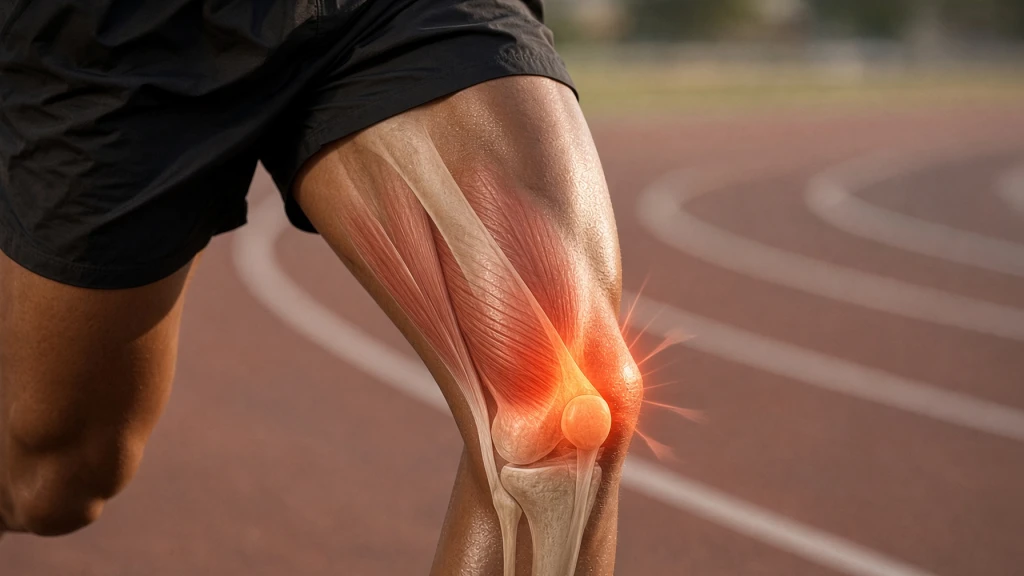
Every time your knee bends and straightens, the muscles at the front of your thigh contract, tighten their tendon, and pull the kneecap down into a shallow groove on your thigh bone, which it is meant to glide along. That pull raises the pressure inside the joint. If the pressure climbs too high and the cartilage underneath is not healthy, the surfaces start to rub, and that is what inflames the joint and produces the sharp catch people feel on a particular step or in the bottom of a squat.
Whether the pressure stays reasonable comes down to how the kneecap tracks. In a well-aligned leg, it runs straight up and down its groove. But if your foot rolls in, as it does with flat feet or excessive pronation, the whole lower limb is dragged into internal rotation. Your hip then fights back by externally rotating the leg to control it, because the foot cannot function rolled inward while you walk and run. That constant tug-of-war pulls the kneecap diagonally rather than straight, and the maltracking drives the pressure up further and speeds the wear.
Here is the part most people miss: the same maltracking can come from the top down. Someone with perfectly normal feet but weak hip and glute muscles lets the thigh rotate inward from above, and the kneecap is pulled off its track just the same. It also runs the other way. A heavily pronating foot paired with strong glute control can hold that internal rotation in check and keep runner’s knee from ever showing up. So this is rarely a problem of the knee alone.
Why it is worse on the stairs, running, and after sitting
Going down stairs is the classic trigger because your thigh muscles are working eccentrically, lengthening while they contract to absorb your body weight on each step. That braking pull jams the kneecap hard into its groove and spikes the pressure inside the joint, so an already irritated surface complains loudly.
Running is the same idea on repeat. Every stride, the quadriceps fire to absorb the landing, the joint pressure builds, and instead of one movement it is stride after stride of repetitive stress travelling up the leg.
The ache when you stand up after sitting a while, sometimes called the theatre sign, tends to appear only once the problem has been simmering for a bit. Rising from a bent knee to a straight one loads the joint to get you up, and if there is acute swelling or the cartilage is already worn, that is enough to set it off. Early on, you would not usually notice it. All three patterns tell me the same thing: whenever the pressure in the kneecap joint rises, the pain comes back, which is a fairly clear sign the joint is being overloaded and wearing.
How I work out whether it is your foot or your hip
This is where a proper assessment earns its keep, because you cannot tell the driver from the pain alone. I look at your foot posture, but more importantly at how the foot behaves when you move. A foot that looks structurally normal yet pronates heavily as you walk, dragging the limb into internal rotation, points the finger downward at the foot. If the foot looks fine but a single-leg squat shows the hip giving way and the knee caving inward, that points upward to the hip. Often it is a mix of both.
Alongside tests that confirm the condition itself, such as the Clarke’s test and the patellar grind test, I use a simple but telling trick to find the driver. I get you to do a single-leg squat naturally, then repeat it while I guide and control the leg. If steadying the limb makes your pain disappear, and letting it move freely brings it straight back, that tells me a great deal about whether the foot or the hip is behind it. Watching your gait and testing the strength around the knee, hip and foot fills in the rest. Where it helps, a gait analysis lets me see the whole chain working under load.
Why treating the knee alone is not enough
Once I know what is driving it, the plan follows the cause, not just the sore spot. When the foot is the culprit, we work on controlling that pronation, usually with customised foot orthoses and advice on footwear that supports rather than feeds the roll. But this is never a single-treatment problem. We settle the irritated joint, where focused shockwave therapy on the knee can help, and we build strength through the glutes, quadriceps, hamstrings and the small muscles of the foot. That strengthening is what carries people back to comfortable running, and the strongest evidence sits behind combining hip and quadriceps work rather than training the knee in isolation. [1] [2]
Can you keep running? Honestly, yes and no, and it depends on how bad it is. If the knee is very swollen and even walking hurts, that is not the time to run. But if you are only starting to feel it, I usually want you to keep running, because a knee that stops moving simply stiffens up and becomes a bigger job later. What matters is how you run. Shortening your stride and lifting your cadence, so you take smaller, quicker steps, cuts the impact travelling through the knee, so the joint takes less load and the symptoms ease without you losing fitness. The real move is to get it assessed, so you know where your knee stands and what it can safely handle.
The mistake that costs runners the most
The one that costs people the most time is stopping their runs, or all their sport, the moment they feel a bit of pain. With any knee problem, the last thing you want is a joint that stops moving, because that just leaves it stiff, and cutting out exercise does nothing for the knee or the rest of your health. The opposite mistake is to push through everything and assume you will end up needing surgery anyway. When a knee is injured there are usually ways to improve and manage it, surgery is not the only road, and it is not a guaranteed fix even when it happens. The far better path is to get it checked early and managed early, so you can keep doing what you enjoy with as little pain as possible.
Have your knee, and how you load it, assessed
If the front of your knee bites on the stairs or nags after a run, it is worth finding out whether it is coming from the knee itself, the foot, or the hip before it wears any further. Book a consultation with any of our podiatrists in Singapore for an assessment of the knee, your gait, and how you load the leg, along with a plan built around what is actually driving it.
Frequently Asked Questions About Kneecap Pain on Stairs and Running
Is kneecap pain going down stairs always runner’s knee?
It is the most common cause by a distance, but it is a symptom, not a diagnosis. Chondromalacia patellae, patellar tendonitis, or an iliotibial band problem can all feel similar, and the two runner’s-knee terms are used so loosely that even clinicians blur them. What sorts it out is your activity history plus a hands-on assessment, never the stair symptom on its own.
Why does the front of my knee hurt going down stairs but not up?
Going down, your thigh muscles work eccentrically, lengthening while they contract to control your weight, which drives the kneecap hard into its groove and spikes the pressure inside the joint. Going up loads the muscles differently and presses the kneecap in less, so an irritated joint tends to complain far more on the way down.
Can weak hips cause kneecap pain even if my feet are fine?
Yes. If the glute muscles that steady your leg are weak, the thigh rotates inward from above and pulls the kneecap off its track, in the same way a collapsing arch does from below. That is why some people with normal feet still get it, and why hip and glute strengthening is often a bigger lever than anything done at the foot.
How should I change my running if my kneecap is hurting?
In most early cases I would rather keep you running than have you stop, because a knee that stops moving stiffens up. The useful change is your stride: shorten your steps and lift your cadence so each footfall sends less impact through the knee. Get it assessed first, though, so you know how much your knee can currently take.
References
- Neal BS, Griffiths IB, Dowling GJ, et al. Foot posture as a risk factor for lower limb overuse injury: a systematic review and meta-analysis. J Foot Ankle Res. 2014;7(1):55. doi:10.1186/s13047-014-0055-4.
- Lack S, Barton CJ, Sohan O, Crossley K, Morrissey D. Proximal muscle rehabilitation is effective for patellofemoral pain: a systematic review with meta-analysis. Br J Sports Med. 2015;49(21):1365-1376. doi:10.1136/bjsports-2015-094723.