Most sore toenails that get treated as an ingrown settle and stay settled. Some do not. The toe calms down for a week or two after the nail edge is trimmed back, maybe after one small procedure. Then it flares again in exactly the same spot. Same pain, and the nail looking a little more warped than before. After a few rounds of that, most people are understandably frustrated. Nobody has explained why something that looks so simple keeps coming back.
If that sounds like your toe, the question worth asking is whether you are dealing with an ingrown nail at all. Most of the time, a sore toenail genuinely is an ingrown toenail, and standard nail care sorts it out. But every now and then the toe is telling a different story. The one most worth knowing about is a bony growth under the nail. When a toe like that turns up, these are the questions I work through with the patient, roughly in the order they matter.
First, what makes an ordinary ingrown toenail “ordinary”?
An ingrown toenail is a soft-tissue problem. The edge or corner of the nail presses into the skin fold beside it. The skin gets red, swollen, sometimes a little infected, and the pain sits along the side of the nail. The thing about a soft-tissue problem is that it responds to soft-tissue care. Free the offending nail edge, settle the inflammation, sort out the trimming and the footwear, and the toe settles for good.
So the real signal is not that your toe hurts. Plenty of things make a toe hurt. The signal is what happens after it gets treated properly. A genuine ingrown nail, dealt with correctly, stays settled. Even one that keeps coming back usually responds to a partial nail avulsion, a small procedure that removes the troublesome nail edge for good. So when a toe keeps flaring after the nail is properly dealt with, the nail is probably not the whole story.
What is the clue that it isn’t an ingrown at all?
The single most useful clue is a firm, fixed lump that does not behave like inflamed skin.
Inflamed skin around an ingrown nail is soft, puffy, and tender, and it squashes down a little under gentle pressure. A bony growth does not. Press the lump and it feels hard. It stays put in exactly the same spot week after week, and it does not flatten when you push on it. That is bone you are feeling, not swelling. It tends to sit under or right at the tip of the nail. An ingrown nail, by contrast, bites in along the side.
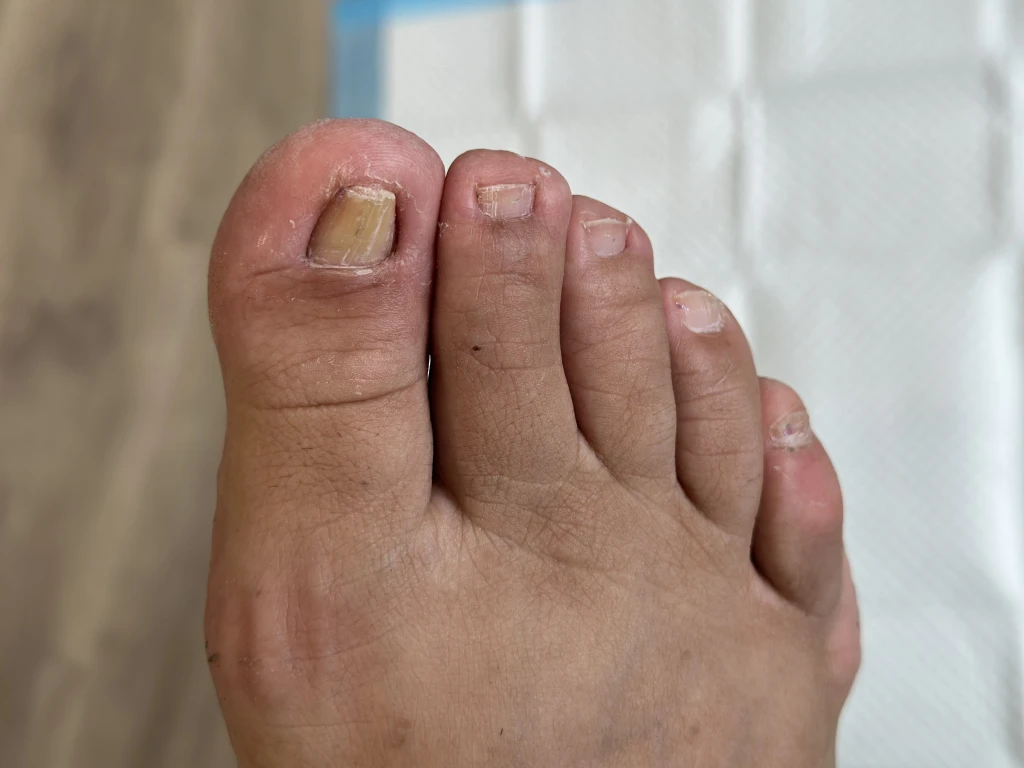
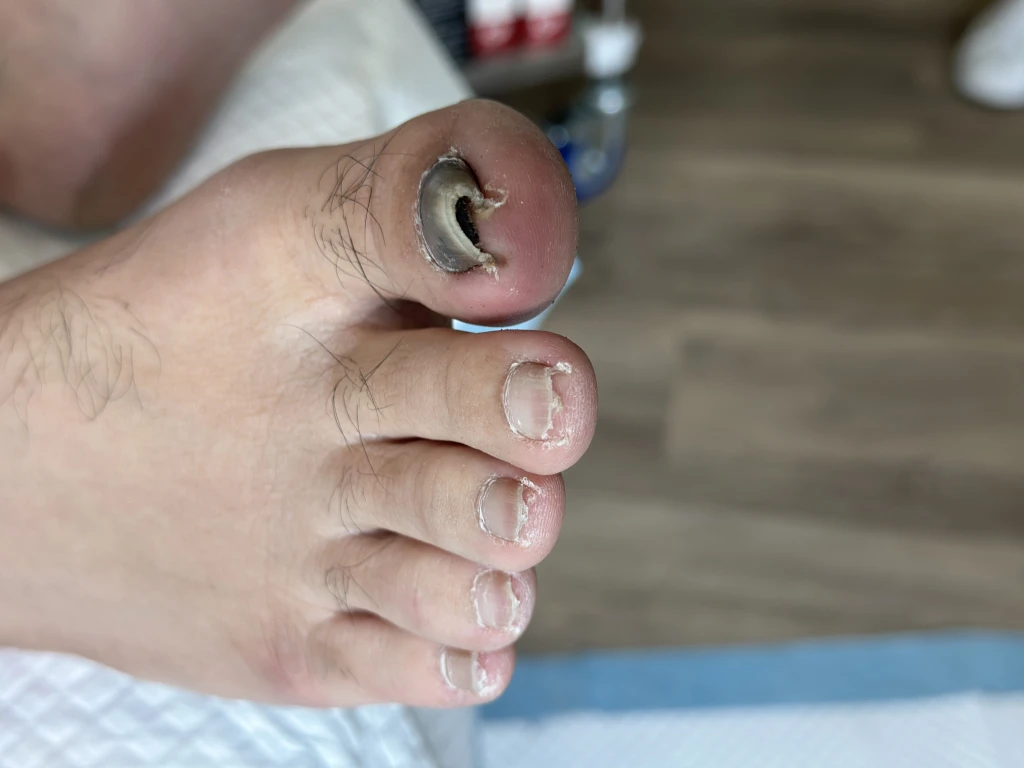
The nail above it gives you a second clue. As something pushes up from underneath, the nail starts to lift, curl away from the skin, thicken, or grow at an odd angle. An ingrown nail digs in. This one looks pushed up. When I see a firm fixed lump plus a nail that keeps deforming, the pattern points away from the skin. It points toward the bone beneath it.
So what is actually growing under there?
The bony cause has a name: a subungual exostosis. It is a benign overgrowth of bone and cartilage from the tip of the toe bone (the distal phalanx). It usually sits under the big toenail. Benign means it is not a cancer. It is simply extra bone, growing in a place where there is almost no room to spare. That is why something quite small can cause so much trouble.
As the spur grows upward, it presses on the underside of the nail and lifts it. That is what produces the warped, raised nail and the tender point right at the tip. And all of that is happening exactly where an ingrown nail or a wart would sit. So the bony cause is easy to miss on a first look. The lump gets read as inflamed skin, and the toe gets treated as a nail problem. The real driver, sitting a few millimetres deeper, goes unaddressed.
This often follows a knock to the toe. A stubbed toe, a dropped weight, a hard kick in sport. The bone responds by laying down a little extra bone at the tip over the following months. It also shows up in people whose toes take repeated impact: runners, footballers, and dancers. And in plenty of cases there is no remembered injury at all. So the absence of a dramatic accident does not rule it out.
How do you tell the difference for certain?
You cannot reliably tell bone from soft tissue by looking at the surface, which is exactly why this gets missed. The way to settle it is a plain X-ray of the toe.
This is the part patients are often surprised by. They expect a sore toenail to be a nail conversation, and instead it becomes a bone conversation. But a subungual exostosis shows up clearly on an X-ray. It reads as a small bony spur projecting from the tip of the toe bone. A true ingrown nail does not. That one image usually ends a long run of nail treatments that were never going to fix a bone problem. They were aimed at the wrong tissue.
This is also why I am cautious about repeated nail procedures on a toe that keeps relapsing. If the bone underneath is doing the pushing, trimming the nail again gives short-term relief at best. The toe is back where it started a few weeks later.
What about the other things it gets confused with?
A bony growth is not the only thing that can masquerade as an ingrown nail, and it helps to know the company it keeps.
Old nail trauma, like a subungual haematoma from a crushed toe, leaves a dark, bruised nail that loosens and grows out abnormally. The difference is that trapped blood grows out over months. A bony lump stays fixed, and the nail keeps re-deforming as it grows. A wart tucked into the nail fold can also mimic a lump. But a wart is soft, sometimes grainy with tiny dark dots. It tends to hurt when you pinch the toe side to side, not when you press down on the nail. The exostosis is the one that hurts most when the nail is pressed down onto the bone beneath it.
None of these are things you need to diagnose yourself. The point of knowing them is simply this: a sore toenail has more than one possible cause. A toe that keeps acting ingrown without ever settling is worth a proper look, not more of the same.
Okay, what would you do if you were me?
If your toe keeps behaving like an ingrown nail but never settles, and you can feel a firm lump that stays hard and fixed while the nail keeps distorting, I would stop assuming it is purely a nail problem. I would have it assessed as a possible bone problem.
A proper assessment starts with the history. How did the toe start troubling you, was there a knock, how many times has it been treated as ingrown without lasting relief. Then a careful look at the lump and the nail to read whether this is soft tissue or something firmer underneath. Where the pattern fits a bony cause, the next step is an X-ray to confirm it. That is what separates a bone problem from a nail one once and for all.
And if it really is a bony growth, what happens then?
I want to be honest about where this goes if it is a subungual exostosis, because the right expectations matter. Conservative care does not make bone disappear. What it does is confirm the diagnosis, keep the toe comfortable with careful nail care and pressure relief, and ease the footwear pressure on the toe tip. The definitive answer for a growth that keeps causing pain and nail deformity is surgical removal of the bony spur. That is done by a foot-and-ankle or orthopaedic surgeon. Podiatry’s job is to recognise the pattern early, arrange the imaging, manage the nail and footwear, and refer for that surgical opinion when it is the right step. Not every small, barely-symptomatic lesion needs surgery straight away. But a painful, deforming one usually does. Getting onto that path sooner spares you the repeating cycle of nail procedures.
If your toenail keeps getting treated for an ingrown nail and keeps coming back, book a consultation with any of our podiatrists in Singapore at Straits Podiatry, at any of our three clinics. We can work out whether the problem really is the nail, or the bone sitting just beneath it.