
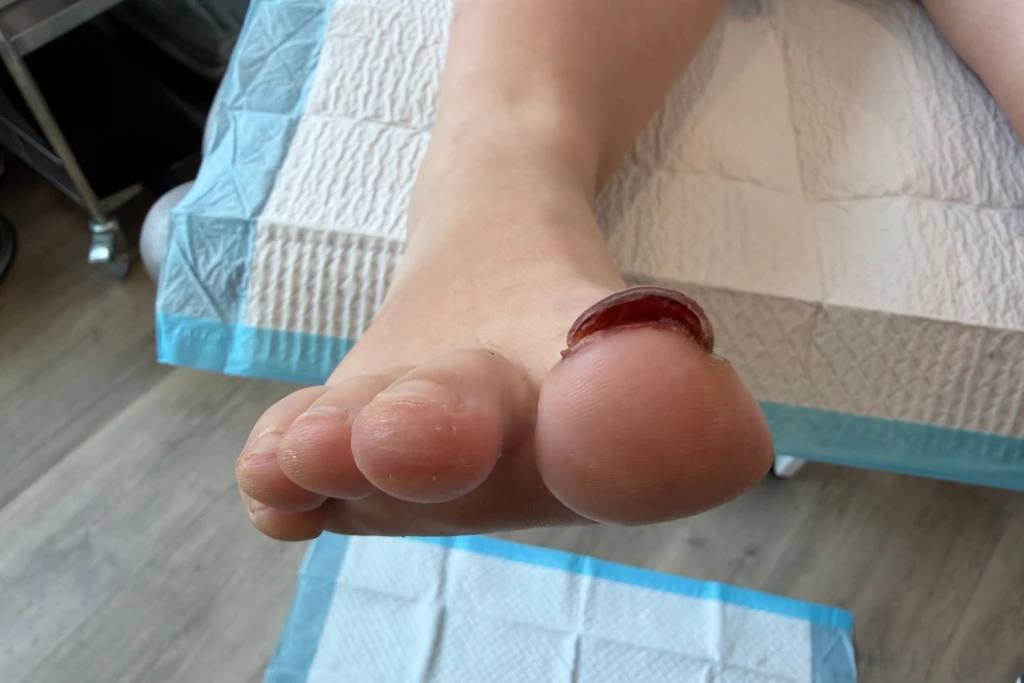
There is a moment in the shower when people first notice it: a patch of the toenail has gone pale and hollow-looking, lifting away from the skin underneath. The nail near the front no longer sits flush and pink. It does not always hurt, which is the part that catches people out. A thing that does not hurt is easy to leave alone for months. So they towel off and make a mental note to look at it later. Later quietly becomes never, until the gap has spread far enough that it is hard to ignore.
If that sounds like your toe, here is the thing worth knowing before you panic. The separation itself is usually mechanical, not a disease. The medical word for it, onycholysis, just means the nail plate has let go of the bed below. What matters is not the gap on its own. It is what caused the lift. And it is what might be quietly growing in the warm space it left behind. When a nail like that comes in, this is roughly the order I work through with the patient.
First, what has actually happened to the nail?
Your nail plate normally sits bonded to the nail bed, the layer of skin directly beneath it. That bond is what gives a healthy nail its pink colour. You are seeing the blood supply in the bed through a translucent plate. When the plate detaches, air slips into the space between the nail and the bed. Light no longer passes through to pink skin, so the lifted area reads as white, yellowish, or grey. The surface looks slightly hollow because there is now a gap underneath.
That gap matters for a reason patients do not expect. The space between the lifted nail and the bed is warm, dark, and easily traps moisture. In our climate, that is the part that catches people out. It becomes a comfortable pocket for fungus or bacteria to settle into. So a lift that started for a completely innocent reason can later turn discoloured or start to smell. The separation is one problem. What grows in the gap afterwards is a second, separate one.
Why did it lift in the first place?
Onycholysis is usually the end result of something acting on the nail over time, rather than a condition in its own right. A few causes come up far more often than the rest.
The one I see most in Singapore is repetitive pressure from shoes. Enclosed sports shoes that are slightly too short, or narrow work and school shoes, let the front of the nail jam against the toe box with every step. The nail is not knocked off in one go. It is gradually levered up over weeks of running, court sports, or walking in tight shoes. Moisture feeds the same problem. Feet that stay damp inside socks and covered shoes all day soften the skin and weaken the bond. In our heat, most of us are sweating into our shoes far more than we realise.
Then there are the causes that are less about the shoe and more about the nail itself. A fungal nail invades under the plate and lifts it from the front edge or the side. It usually travels with thickening, crumbling, and a yellow-brown discolouration rather than a clean pale gap. Skin conditions such as psoriasis can lift the plate too. That often pairs with small pits in the nail surface or an oily-looking patch at the edge of the separation. And long-term gel or acrylic wear, aggressive cleaning under the nail, or repeated contact with harsh solvents can all weaken the attachment over time.
What about a stubbed toe or a dropped weight?
There is also the obvious one, which I want to set aside deliberately, because it behaves differently. If you stub your toe hard, drop something on it, or jam it at the front of your shoe in one violent moment, that is a single hard knock. It usually bleeds under the nail. That shows up as a dark red, purple, or black patch rather than a pale hollow one. It is often painful straight away from the pressure of the trapped blood. It can certainly lift the nail later as it grows out, but it is a one-off injury you can point to. The kind of lifting this blog is about is the slow, often painless sort, where there was no single dramatic moment. That distinction matters, because the slow kind means the cause is still active and still needs finding.
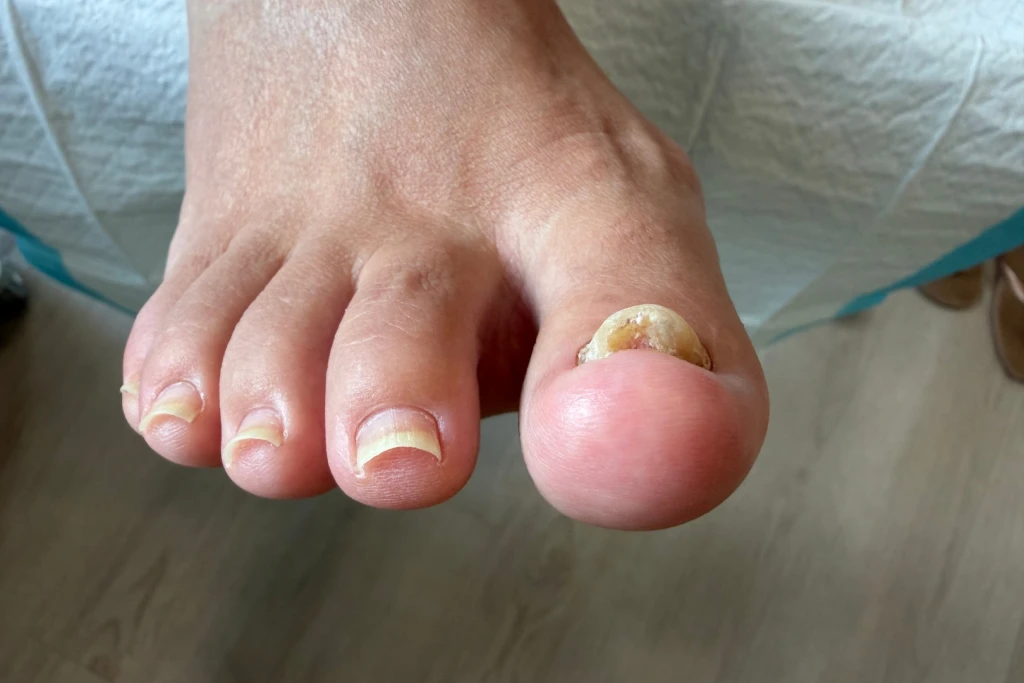
Will it stick back down?
This is the question almost everyone asks, and the honest answer is the part people find hardest to hear. A nail that has lifted off the bed does not re-stick. Once the plate has separated, that section stays separated. The bond does not reform on the part that has already let go.
What actually happens is better than that sounds. The nail grows. As the new nail grows forward from the base, it comes in attached to the bed, the way a healthy nail does. A toenail takes months to fully replace itself. Over that time, the lifted portion gradually moves toward the front and is trimmed away, while the new growth behind it comes in bonded. So the nail does recover, but through replacement, not reattachment. The catch is simple. If whatever caused the lift is still acting on the nail, the new growth lifts as well, and you never seem to make progress. That is why the work is aimed at the cause, not just the gap.
What should I do while it grows out?
Most of caring for a lifted nail is about protecting the gap and removing whatever is still pulling the plate up.
Keep the lifted section trimmed short so it has less leverage to catch on socks and shoes and tear further. Every time a lifted nail snags and lifts more, you lose ground. Keep the foot as dry as you reasonably can. In our climate, that means changing out of damp socks, airing shoes between wears, and drying between and under the toes properly after showering. Resist the urge to clean deep under the lifted nail with a sharp tool, because aggressive digging widens the separation and pushes debris further back. And give your footwear an honest look. If the front of your shoe is jamming the nail, no amount of careful trimming fixes a problem the shoe keeps re-creating.
What home care cannot do is tell you which cause you are dealing with. A lift from a tight shoe, a lift from fungus, and a lift from psoriasis can look similar at a glance but need quite different management. Treating the wrong one wastes months. Some signs mean it is worth having looked at properly rather than waiting it out. The lifting is spreading. The nail is thickening or discolouring. There is pain, swelling, or discharge. Or you have diabetes or poor circulation.
Okay, what would you do if you were me?
I would start by settling the cause rather than guessing, because everything else follows from that. When a patient comes in with a nail separating from the bed, my first job is working out why. The assessment looks at the pattern of the lift, the colour and texture of the nail, the state of the surrounding skin, and the footwear the nail spends its day in. Where a fungal cause is suspected, a sample can be taken to confirm it before committing to a long course of antifungal care. The lifting alone does not prove fungus is present.
From there the plan is matched to the cause. That can include careful reduction of the lifted, thickened, or distorted portion of nail, PACT antifungal therapy where a fungal infection is confirmed, footwear and pressure-offloading advice where shoes are the driver, and diabetic foot screening where circulation or nerve supply needs checking first. The aim is to remove what keeps lifting the nail so the new growth can come in attached.
One honest caveat. If the cause has been running for a while, the nail can take its full replacement cycle to look normal again. So the goal early on is stopping the lift from spreading, not an instant fix. That is a perfectly good outcome, and for most people it is exactly what they need.
If your toenail is lifting away from the bed and you are not sure why, or it is not settling as the nail grows, book a consultation with any of our podiatrists in Singapore at Straits Podiatry, at any of our three locations, for an assessment and a plan built around the actual cause.