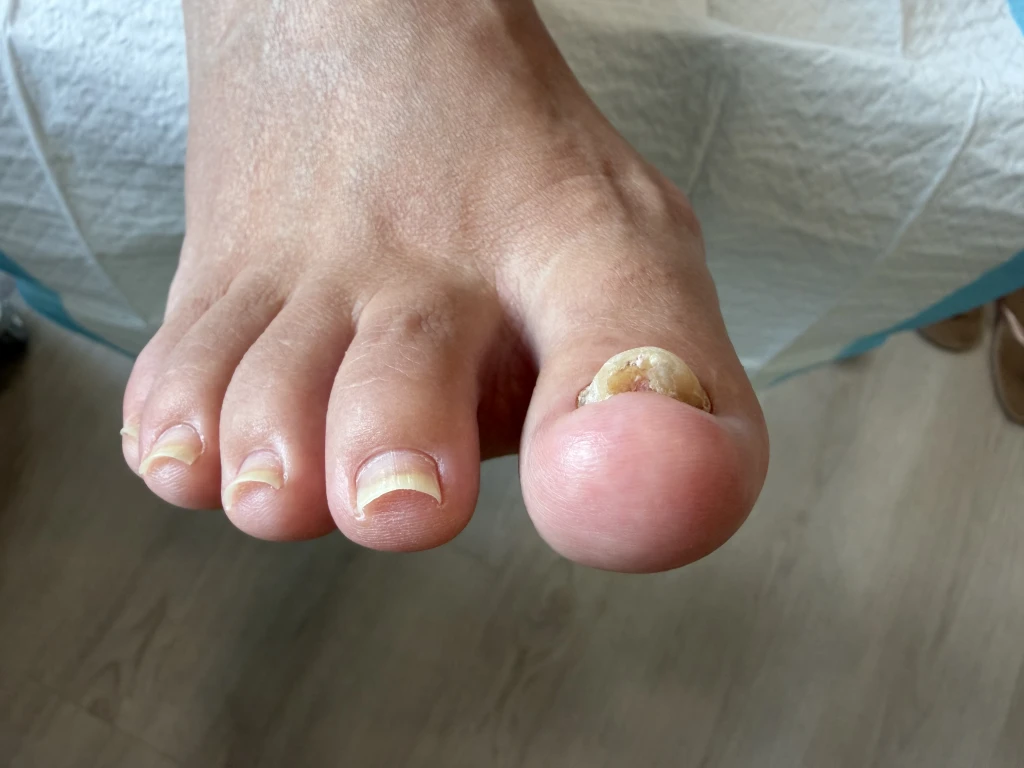
Why would a toenail that curls in on itself hurt when it has not even broken the skin? That is the question I keep getting from patients whose toe aches to press on, yet looks almost normal at the corner. They came in expecting the classic ingrown picture, an angry, red, swollen nail fold. Instead the skin is more or less intact. The discomfort sits as a deep, squeezing ache, worse in tight shoes or after standing too long. Most of them open with, “there is nothing to see, so why does it hurt this much?”
If that sounds like your toe, the answer is usually in the shape of the nail, not the state of the skin. A normal toenail is fairly flat across its width, sitting like a gentle dome over the nail bed. Some nails grow with a much tighter curve from side to side. The two edges turn downward and inward as the nail grows forward. Once that curve gets pronounced, the nail behaves like a clamp. We call this a pincer nail (an over-curved or involuted nail). It is a different problem from an ingrown, even though the two are easy to confuse. When a toe like that turns up, these are the questions I walk through with my patients, in the order they come up.
First, what is actually happening to the nail?
Picture the nail as a sheet of keratin laid over soft tissue. In a pincer nail, that sheet is over-curved. As it grows out, it tightens its grip on the soft tissue and bone underneath, a bit like a U-shape closing in on itself. The edges press down into the nail bed and the deeper structures, rather than out into the skin at the side.
The nail bed underneath is densely packed with nerve endings. When an over-curved nail presses down on it continuously, the tissue has nowhere to go. That sustained squeeze is what produces the deep ache. You feel it as tenderness when you press on top of the nail, and a sharp jab when a shoe pushes the sides of the toe together. In our climate, a lot of people are in closed work shoes through a humid day. The toes swell slightly and the squeeze gets worse by the afternoon. I hear “it is fine in the morning and unbearable by evening” fairly often, and that pattern fits a pincer nail well.
How is this different from an ingrown?
This is the part worth getting straight, because it changes what actually helps.
An ingrown toenail is fundamentally a skin problem driven by a nail edge. A spike or corner grows sideways into the flesh of the nail fold and pierces it. The body reacts with redness, swelling, and sometimes infection. That is why an ingrown tends to break the skin and bleed. The classic fix targets that offending edge.
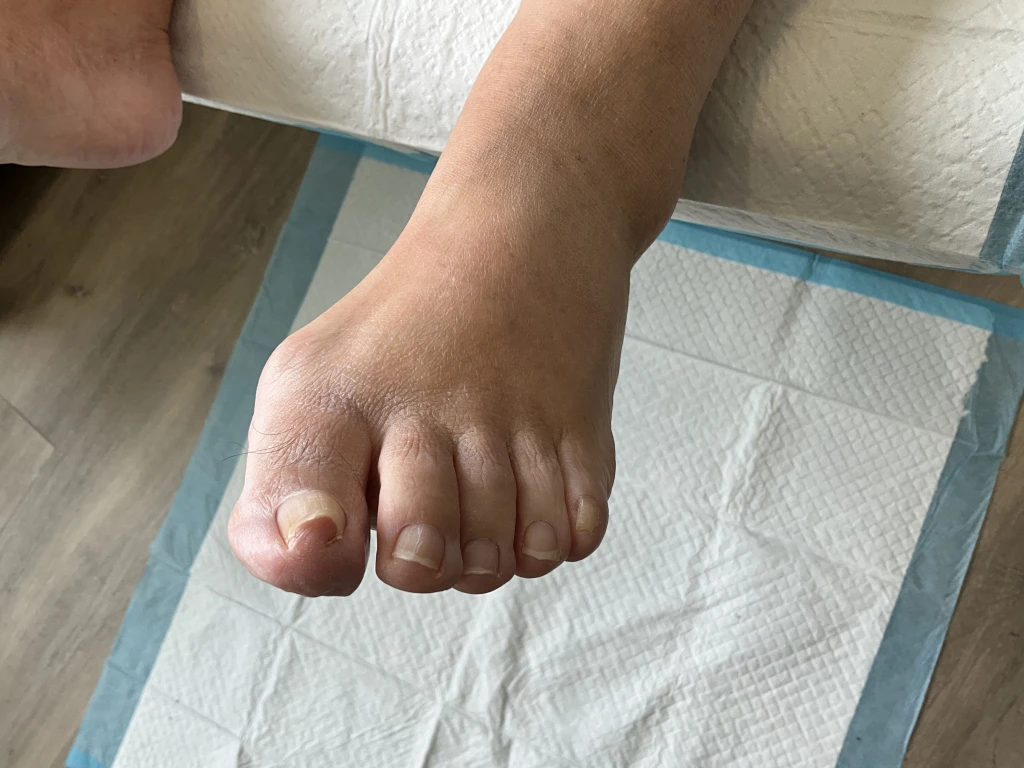
A pincer nail is fundamentally a shape problem. The whole nail plate is curved too tightly. It squeezes downward and inward, compressing the nail bed while the skin stays closed. You get real, sometimes sharp pain with very little to show for it on the surface. The two do overlap, and an over-curved edge can certainly start catching the skin and tip over into a true ingrown. But on its own, a pincer nail is the toe that hurts deep down without ever looking dramatic. Say you have had a corner cut back several times and the ache keeps returning without the skin ever really breaking. That repeating pattern is a strong clue you are dealing with curvature, not a true ingrown.
Why is it getting more curved over time?
For a lot of people the over-curvature is there from the start, written into how that nail grows, and it often runs in families. So if a parent has the same tightly curled toenails, that is not a coincidence.
It can also develop or worsen over the years. A few things pull a mildly curved nail into a tighter pincer shape. Wider shoe pressure squeezes the toe from the sides. A previous injury to the toe can do it, as can certain types of nail fungus that thicken and distort the plate, and the natural changes to a nail as we get older. In the more advanced cases the curl is tight enough that the two edges almost meet underneath. The nail can then look like a tube or a pinched trumpet. It does not need to puncture the skin at any point to be genuinely painful. That is exactly why it gets dismissed for so long.
Can it be fixed without surgery?
In most cases, yes, and the first steps are simple. The starting point is taking pressure off the toe. Roomier shoes with a wider, deeper toe box help. So does swapping narrow work shoes for something kinder on long days. Cutting the nail straight across rather than rounding the corners helps too. All of it reduces the load on an already over-curved nail. Keeping the skin around the nail supple, rather than letting it dry and harden in air-conditioning, helps too. These measures calm the symptoms. What they do not do is change the shape of the nail, and that is where the more interesting option comes in.
How does nail bracing reshape the nail?
For an over-curved nail that keeps causing trouble, nail bracing is the option that addresses the curvature rather than just the symptoms. A thin composite brace is bonded flat across the surface of the nail. Rather than pulling on the nail, it holds the flatter part of the plate and guides the nail to grow into a flatter shape as it moves forward. Over several months, that gentle guidance eases the curled edges away from the tissue they were compressing. There is no anaesthetic, no cutting, and no wound to recover from. That is part of why it suits people who want to steer clear of a procedure. The brace is replaced as the nail grows out. The reshaping is gradual, so it does ask for some patience.
I will be honest that bracing is not the right answer for every nail. The curvature may come from deep in the nail root. The plate may be heavily thickened by a fungal infection, or there may already be an infected ingrown edge that needs settling first. In those cases a brace alone may not be enough. The plan might instead involve managing the fungus, addressing the offending edge, or in some cases a small procedure on the nail. Which path fits depends on what the nail looks like up close, and that is the part worth getting assessed properly rather than guessing at.
Okay, what would you do if you were me?
If a toenail aches deep down without ever looking like a textbook ingrown, I would have the shape of the nail looked at. Trimming it back again and hoping does not get to the cause. A proper assessment reads how tightly the nail is curved and how it sits against the nail bed. It also checks whether any fungal change or skin reaction is feeding the problem, and whether the edges have started catching the skin. That picture is what decides whether reshaping, simpler pressure management, or another approach makes the most sense for your toe.
From there, the plan is honest and specific. For a straightforward over-curved nail, nail bracing to gradually reshape the plate is often the option that fits. It comes alongside guidance on trimming and footwear to keep the pressure off. If there is fungal involvement or an edge that has genuinely become ingrown and infected, that gets dealt with as part of the plan rather than ignored. One honest caveat: the reshaping is slow and asks for patience. The goal is a comfortable, less-curved nail over time, not an overnight fix.
If your toe has been sore for a while with little to show on the surface, book a consultation with any of our podiatrists in Singapore at Straits Podiatry, at any of our three locations, for an assessment and a clear plan to settle it.