
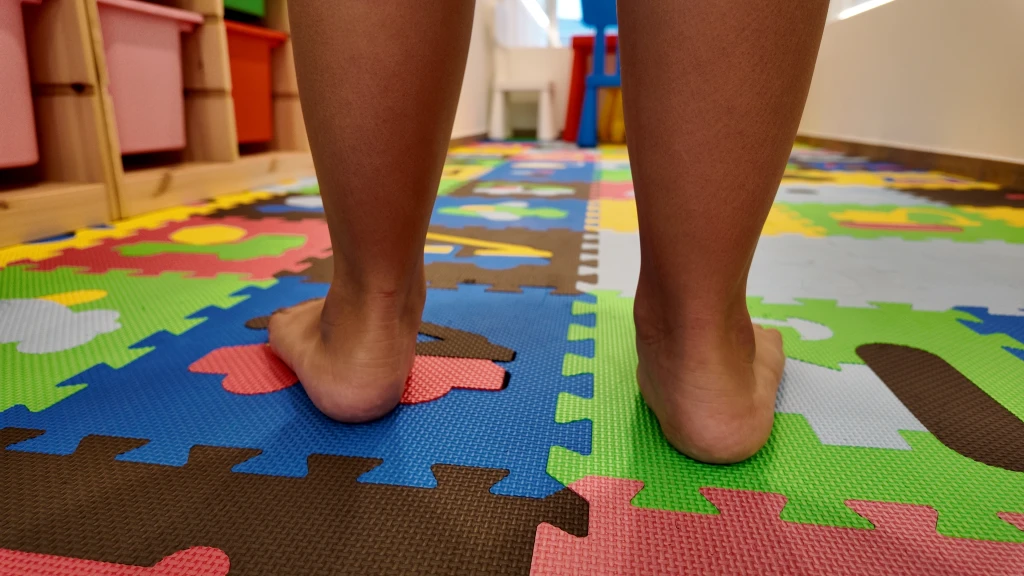
If you have stepped out of the shower onto a tile floor and noticed your wet footprint looks more like a slipper than a footprint, you have probably wondered whether you have flat feet. In Singapore, where most of us walk barefoot indoors and where weekend running and long days on hard mall floors stress the arch differently, the question comes up often. The four checks below take about ten minutes.
Why a self-check matters (and what it isn't)
A self-check is not a diagnosis. It is a triage. A clinician still needs to see how your foot loads when you walk and how the tendons behave under resistance before any plan makes sense. What a self-check does well is tell you whether the question is worth asking.
Most people I see have ignored a low arch for years because nobody around them seemed concerned. The pattern usually changes only when an unrelated problem (a morning heel ache, a knee that complains after a 10km run, a shoe wearing through on the inside) finally drives them in. These tests catch the pattern earlier, while the fix is still simple. Do them barefoot, on a hard floor, in good light, and check both feet separately. Many people have one flat foot and one normal foot without realising it.
Test 1: The wet footprint test
The classic, for a reason. It gives you a quick visual map of how much of your sole touches the ground.
How to do it:
- Wet the soles of both feet.
- Step normally onto a dry, dark surface (brown craft paper, a bath mat, or a darker tile).
- Step off and look at the shape of each print.
What the result means:
- Normal arch. Ball, a narrow band along the outside (less than half the width of the forefoot), and heel. The inner arch is dry, with a clear concave curve.
- Flat or low arch. Almost the entire sole prints, with little or no concave curve. The print looks like a slipper outline.
- High arch. Ball and heel print, but the outside band is very thin or broken entirely.
A flat footprint on its own is not a problem. A flat footprint plus pain, plus shoes wearing on the inside, plus a family history, builds the case for an assessment.
Test 2: The Jack's test (toe-up test)
This tells you whether your flat foot is flexible or rigid, which matters more for treatment than the flatness itself.
How to do it:
- Stand barefoot on a hard floor, feet shoulder-width apart, weight evenly distributed.
- Without lifting your heel, lift the big toe of one foot straight up as far as it will go.
- Watch the inner arch of that foot in a mirror, or have someone watch for you.
What the result means:
- Arch lifts. When the big toe goes up, the inner arch visibly lifts off the floor. This suggests a flexible flat foot, which generally responds well to footwear changes, exercises, and where indicated, custom orthotic insoles.
- Arch does not lift. The arch stays pressed against the floor and the big toe feels stiff or resistant. This points towards a rigid flat foot, which can indicate a more involved structural cause and warrants an assessment sooner rather than later.
- Pain on the inner ankle when you try. Pay attention to this one. Pain along the inner border of the ankle during the lift, especially in adults over 40, can be an early sign of posterior tibial tendon dysfunction, one of the most common drivers of adult-acquired flat foot.
Test 3: The shoe-wear pattern check
Your shoes are a record of how your feet load the ground over weeks or months. Often a more honest record than a brief standing assessment.
How to do it:
- Pick a pair you wear most days.
- Place them side by side and look at them from behind.
- Check three things: the sole wear, the heel counter (the firm cup at the back), and the upper.
What the result means:
- Inner-sole wear and a heel that tilts inward. Sole worn faster on the inside of the heel and forefoot, with the back of the shoe leaning inward, means the foot is rolling inward as you walk. The classic shoe signature of a flat foot.
- Upper bulging outward on the inside. A flat foot pushes against the inner wall of the shoe and the upper distorts over time. Easiest to see in canvas shoes and dress shoes.
- Lateral wear (outside edge worn faster). Opposite pattern, more typical of a high-arched foot.
- Even wear, vertical heel counter. The foot is loading the shoe reasonably evenly. Not a flat-foot signature.
In clinic, I often ask patients to bring their oldest comfortable pair. The wear pattern tells the story faster than any new test.
Test 4: The heel-alignment-from-behind check
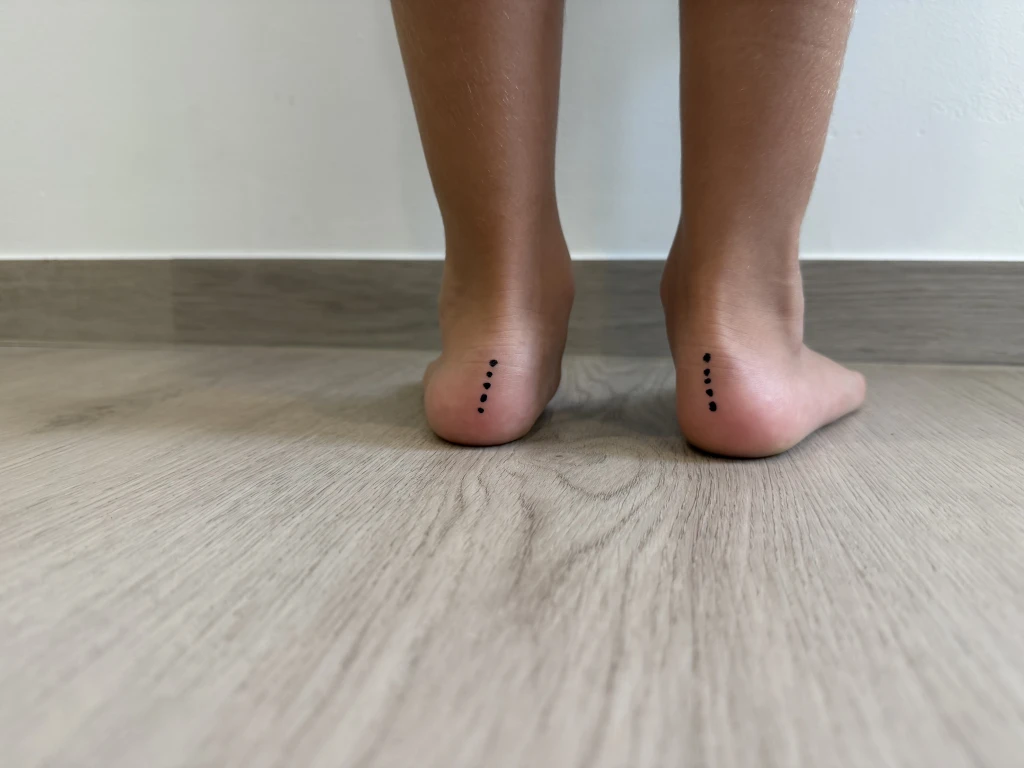
This helps me decide how much the foot is collapsing during stance. It benefits most from a second pair of eyes, or a phone camera.
How to do it:
- Stand barefoot on a hard, level floor, feet hip-width apart, looking straight ahead.
- Have someone take a photo of your heels and lower calves from knee height, perpendicular to your stance.
- In the photo, picture a vertical line down through the centre of each Achilles tendon and heel bone.
What the result means:
- Vertical heel. Achilles and heel form a straight line. Neutral position. What we look for.
- Heel tilts inward. The Achilles forms an inward-leaning curve and the inner ankle bone bulges inwards. Called rear-foot valgus, this is the hallmark sign of a collapsing arch.
- The "too-many-toes" sign. If you can see more than the little toe (and a hint of the fourth toe) poking out beside the heel from behind, the forefoot is rotating outward as the arch collapses. A stronger sign the flat foot is affecting how your foot loads.
- Heel tilts outward. Opposite pattern (rear-foot varus), points away from flat feet towards a high arch.
Save the photo. If you do see a podiatrist, it is a useful baseline.
What your results mean and when to book a podiatrist
A single test pointing towards a flat foot is interesting. Two or more tests pointing the same way, plus symptoms, is when I would book.
Consider seeing a podiatrist if:
- A flat or near-flat wet footprint AND shoes wearing unevenly on the inside.
- The Jack's test produces pain or stiffness, or the arch does not lift at all.
- The heel-from-behind photo shows a clear inward tilt or the too-many-toes sign.
- Persistent foot, ankle, knee, hip, or lower-back pain that has not resolved with rest or footwear changes.
- A child in your family with visibly flat feet AND foot or leg pain, refusal to walk long distances, or tripping more than peers.
- You are over 40 and a flat foot has appeared or worsened on one side, especially with inner-ankle pain.
What a podiatrist adds beyond a self-check is a gait assessment under load, a strength assessment of the supporting tendons, and a structured plan that accounts for your activity level, footwear, and any pain you are carrying. The plan may involve footwear guidance, exercises, custom orthotic insoles, or coordination with physiotherapy where the supporting muscles need rebuilding.
If your self-check has surfaced a concern, the next step is a proper assessment with one of our podiatrists at any of our three clinics in Buona Vista, Orchard, or Paya Lebar. Catching this early, while the arch is still flexible, is usually the difference between a footwear conversation and a longer rehabilitation one. Book a consultation when you are ready.